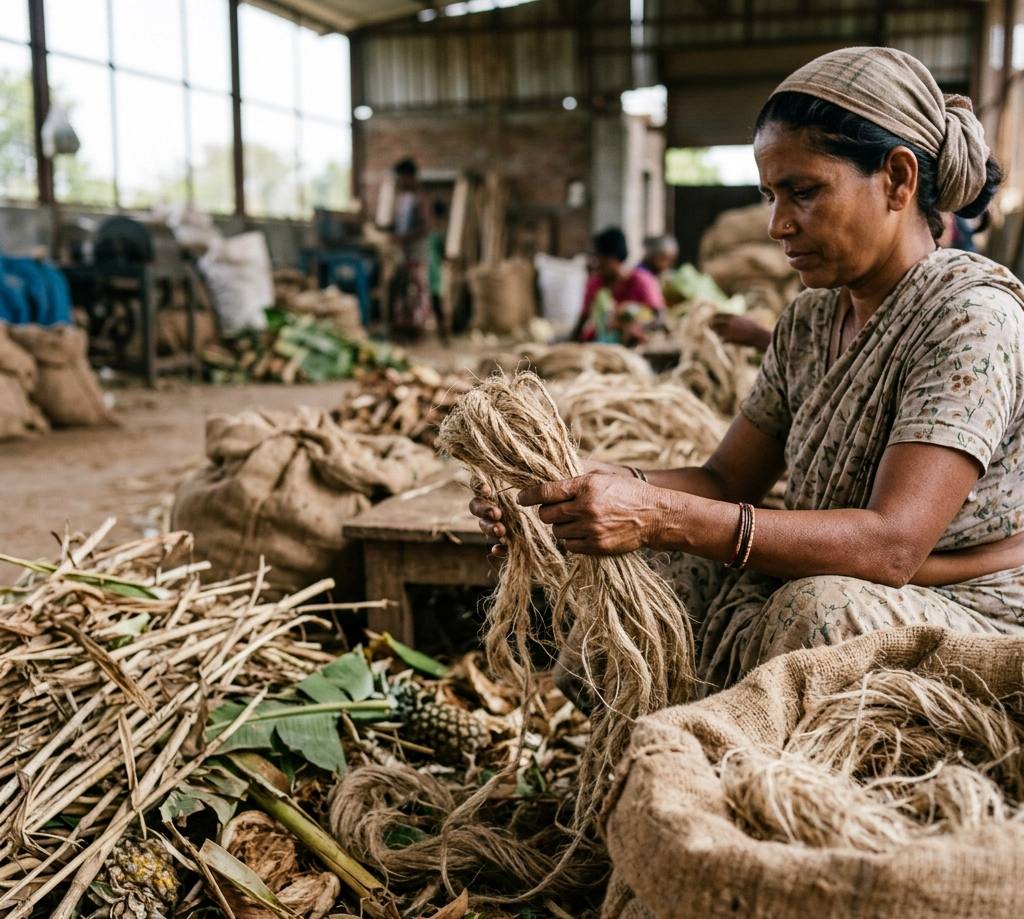
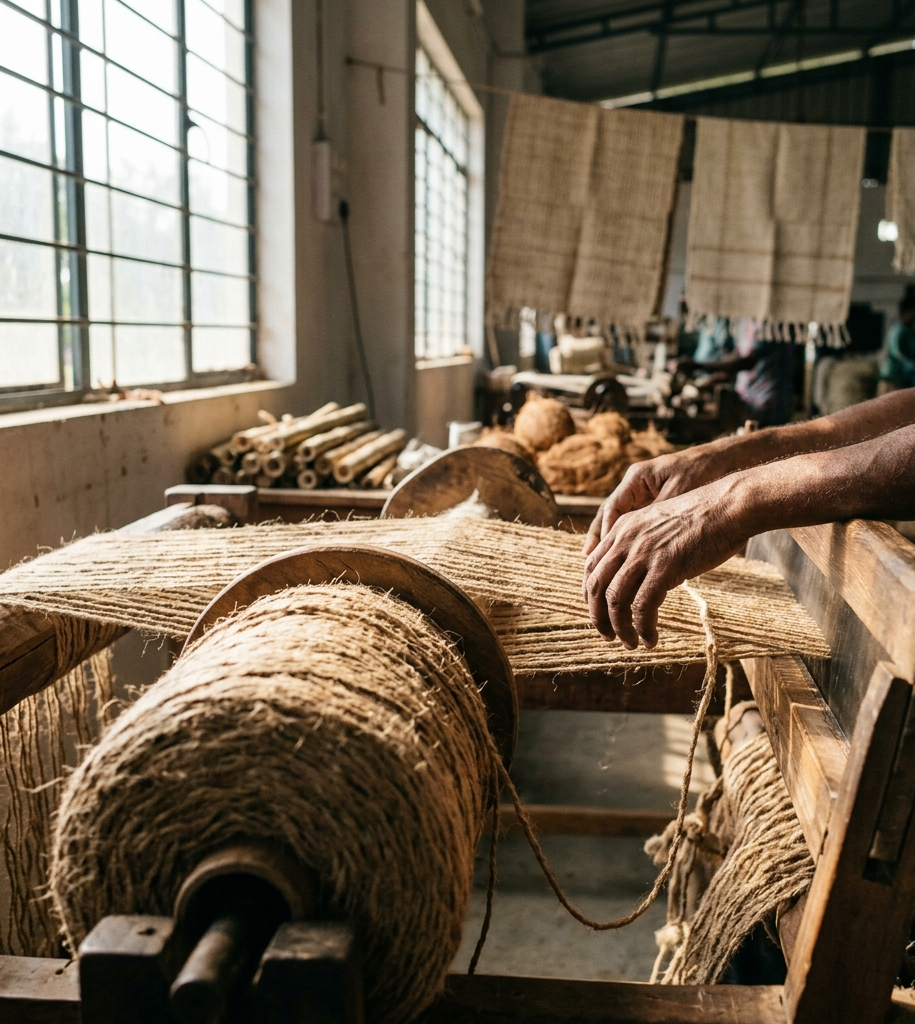
For most of human history, natural fibers like cotton, jute, hemp, flax, wool, silk were used to be manufactured. Then the 20th century happened when synthetics arrived. They were cheaper and endlessly tweakable, and natural fibers were pushed to the margins almost overnight.
Fast-forward to today, and the pendulum is swinging back. The reason is regulation and planet running short on patience for petroleum-based waste.
Plant fibers like hemp, flax, jute, and bamboo share a rare combination of traits of being renewable, biodegradable, and they take relatively little energy to produce. Crucially, the plants utilize carbon dioxide from air as they grow. So, the raw material starts its life as a carbon sink rather than a carbon cost. For a manufacturer staring down emissions targets, that’s a genuinely different starting point than a barrel of oil.
Where Fibers Are Utilized
The most visible action is in transport.
Carmakers have quietly used natural fibers for years. For example, Mercedes-Benz has built flax, hemp, sisal, and wool into vehicle components but it was mostly hidden in door panels and trim. What’s new is that fibers are moving to structural and exterior parts, where the engineering bar is far higher. Swiss firm Bcomp’s flax-based ampliTex and powerRibs technologies, battle-tested in motorsport, are now being scaled for road cars precisely because they cut weight without cutting strength, and lighter vehicles burn less fuel.
Then there’s construction.
According to market analysts, construction is the second-fastest-growing sector for natural-fiber composites, right behind automotive. Hemp, straw, and wool are being woven into insulation, cladding, and wall panels that shrink a building’s carbon footprint while fitting neatly into circular-economy thinking.
Fashion and packaging are running their own experiments.
Designers are spinning agricultural leftovers into materials that didn’t exist commercially a decade ago. Foe example, leather-like textiles made from pineapple leaves and fabric drawn from banana pseudostems that would otherwise be burned or dumped after harvest.
In late 2025, a team unveiled a composite yarn blending basalt with natural cotton, engineered specifically to support cleaner production and the UN’s sustainability goals.
Grand View Research valued the total natural-fiber market at roughly USD 69 billion in 2024, with projections nearing USD 95 billion by 2030. The narrower market for natural-fiber-reinforced composites, the stuff going into cars and buildings is smaller but climbing steadily, with construction and automotive driving most of the growth.
When the money moves like that, it usually means the technology has stopped being a just a science project and started being a supply chain.
Thers’s Always A Catch
Natural fibers love water which can make them tricky to bond with the water-repelling plastics they’re often mixed into and also make them more sensitive to moisture over time. Quality can vary from harvest to harvest in a way that a chemical plant’s output never does.
But that is exactly where the research is concentrating which is better extraction methods, surface treatments, and processing techniques. So, this makes the remaining work about engineering and not about invention.
The takeaway?
Natural fibers are the smart material that you choose on purpose.
FAQ
- What exactly counts as a “natural fiber” in manufacturing?
Natural fibers are obtained from plant sources, animals, or minerals and not petroleum products. The most common industrial natural fibers are all plant-based and include flax, hemp, jute, cotton, bamboo, kenaf, and coir, as well as wool and silk.
- Are natural fibers actually strong enough for serious products?
In many cases, the answer is affirmative. Specifically, flax has a high degree of stiffness along with tensile strength relative to its weight, thus allowing it to be used for automobile structures and exteriors. Where high stress is involved, fibers are used in combination with other materials.
- Why are natural fibers considered better for the environment?
These materials can be recycled, decomposed, and sequester CO2 as they grow, and also need lesser energy in production compared to synthetic fibers. This makes them very well-suited for circular economy and emission reduction initiatives.