Every year, across the paddy fields of India, China, Thailand, and Vietnam, the same scene repeats itself. When the harvest ends, farmers do what they’ve always done with the leftover stalks, they burn them.
And it’s almost a routine.
731 million tonnes of rice straw is produced globally every year. Over 100 million tonnes of that is burned openly in fields. Each hectare of burning releases approximately 7,300 kg of CO2-equivalent. In India’s Punjab alone, 15.4 million tonnes of rice straw go up in smoke after every harvest releasing fine particles (PM2.5), methane, and nitrous oxide into the air that millions of people breathe.
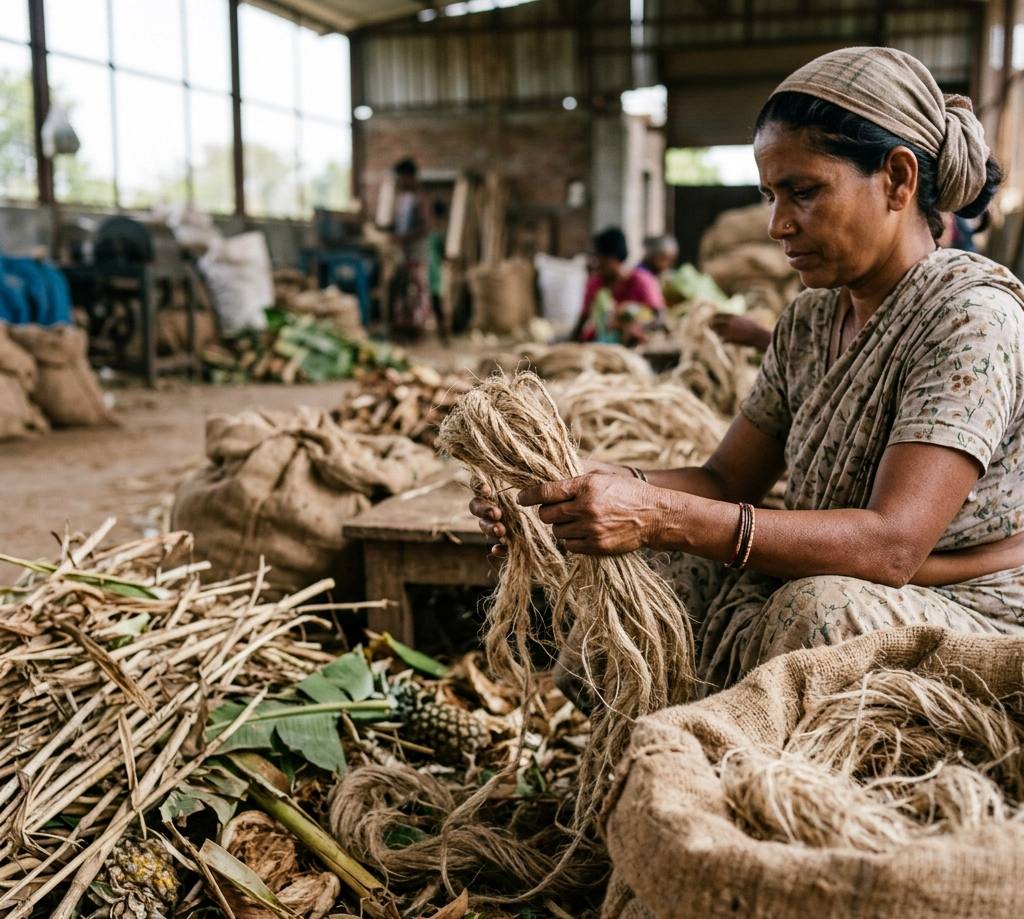
But that straw isn’t waste. It’s a raw material of the field, waiting to become something far more valuable than just smoke.
What’s Inside Rice Straw
Rice straw can be described as being lignocellulosic biomass, which is composed of three main constituents:
- Cellulose (about 32-47 percent)
- Hemicellulose (19-27 percent)
- Lignin (5-24 percent) with some silica
- Ash content
Cellulose is what makes the whole biomass so attractive in the global market today. The substance is a chain of polymers, which can be considered one of the most widespread organic materials on our planet. Cellulose creates a structural part of cell walls, which makes the material strong and biodegradable. When processed to its nanostructure, cellulose becomes something exceptional.
The problem for scientists is the extraction process, which has always included destruction of the cellulose molecule during separation from hemicellulose and lignin. Now, scientists make quick progress in overcoming that issue.
The Extraction Process
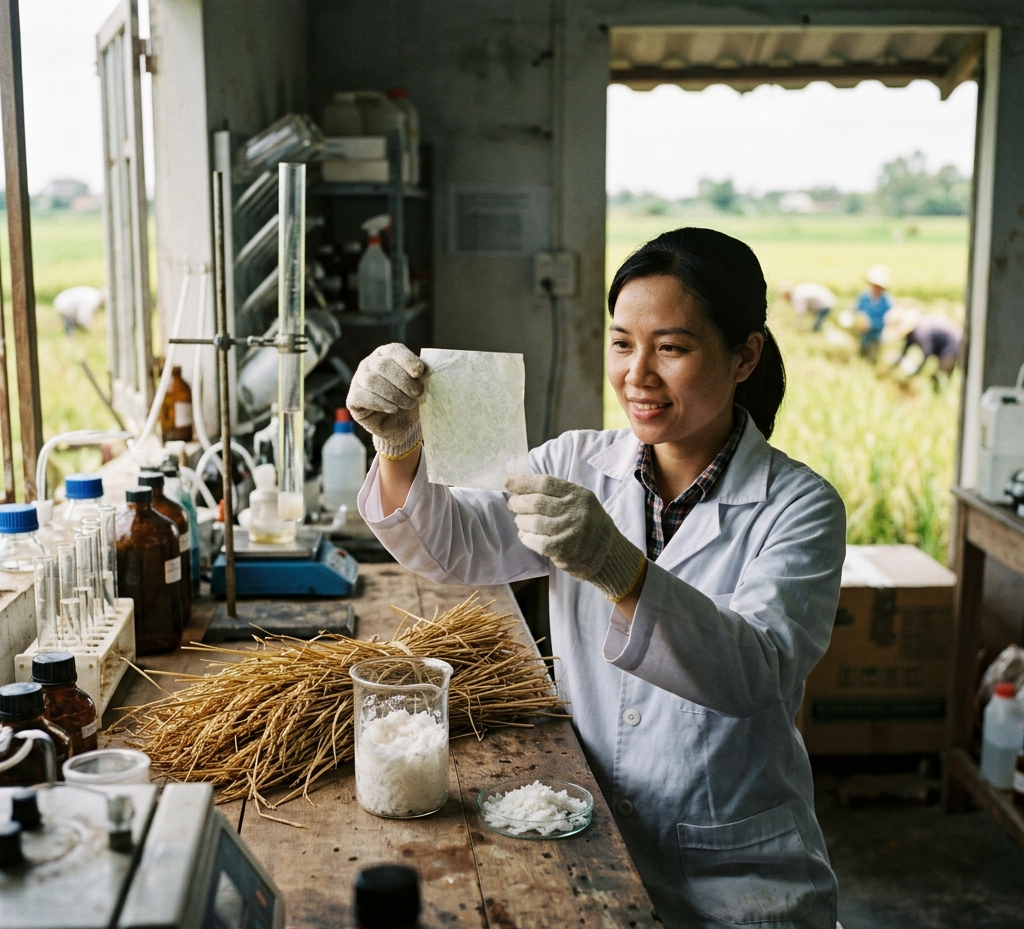
A 2023 study published in Scientific Reports (TERI Deakin Nanobiotechnology Centre / Deakin University) compared three pretreatment methods for pulling cellulose out of rice straw:
- Alkali treatment
- Steam explosion
- Organosolv treatment
All three effectively removed non-cellulosic components. But critically, the subsequent conversion to cellulose nanofibres (CNFs) increased crystallinity from 52.2% up to 65% which is a key marker of structural purity and mechanical usefulness.
A research conducted in 2025 and published in Biomass Conversion and Biorefinery used high-energy ultrasonication coupled with high-shear dispersion to produce CNFs from rice straw. The aim of this method was to reduce the high chemical burden on the environment associated with existing methods of CNF production.
A more advanced method, a study which was conducted in 2025 and published in ScienceDirect, involved the use of improved methods of extracting multiple elements at once from rice straw. These include cellulose, hemicellulose, and lignin, which have various applications after extraction.
What You Can Make from Rice Straw Cellulose
Cellulose extracted from rice straw isn’t destined for one application, it branches into a family of high-value products across several industries.
Cellulose Nanofibres and Nanocrystals (CNFs/CNCs)
On the nanoscale level, rice straw cellulose acts as a reinforcing agent and differs from the rest of the materials obtained from waste biomass. CNFs help in reducing the weight of the material by about 25% while enhancing its tensile strength by up to 42%. CNFs have been applied in making biodegradable packaging films for food, paperboard coatings, building composites, and vehicle parts. The value of the global market for nanocellulose was estimated to be about $504 million in 2025, with a forecasted value of $3 billion in 2035, growing at a rate of 19.8%.
Biodegradable Packaging and Bioplastics
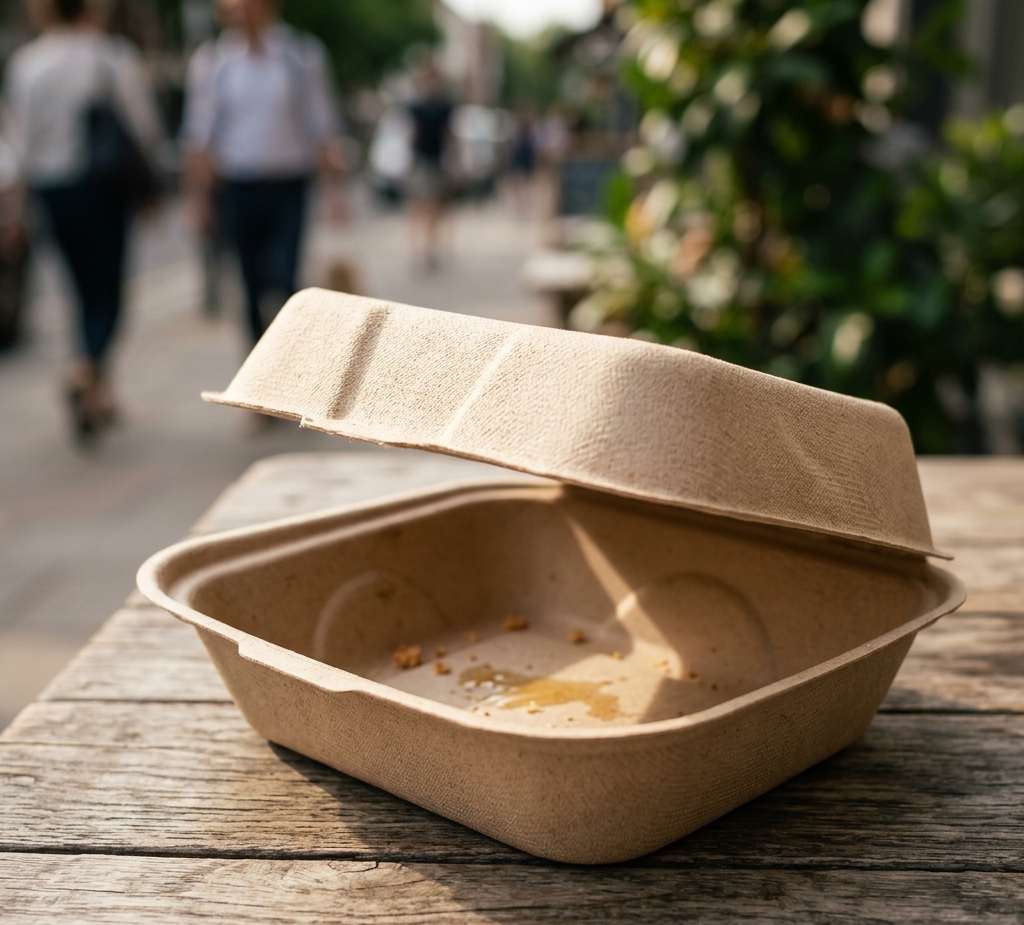
The study conducted using ScienceDirect on ethyl cellulose films highlighted the use of a greener extraction method, which was used on recycled rice straw waste to make films with multiple functionalities such as transparency, flexibility, and biodegradability, capable of acting as substitutes for normal plastic packaging materials used in foods and medicines. In light of more than 320 million tonnes of plastics being produced annually, this avenue presents huge potential.
Smart Fertiliser Delivery Systems
One such application is that of CNF made out of rice straw, which has a suitable zeta potential (-25.2 mV) as well as structure for storing and releasing farm inputs at a controlled rate. The study conducted by Deakin University revealed that rice straw CNF would be useful in controlled release fertilizer formulations, adding value back into the agricultural cycle from whence it came.
Drug Delivery and Tissue Engineering
According to a 2025 review from Food Bioscience (ScienceDirect), studies were underway on the potential use of biomaterials obtained from rice straw polysaccharides in medication delivery systems and tissue scaffolds. Unlike other man-made polymers, these materials decompose into non-toxic products that nourish the soil.
The Economics Behind the Opportunity
Burning rice straw doesn’t just release pollution, it also destroys value.
For every tonne of straw burned, farmers lose 5.5 kg of nitrogen, 2.3 kg of phosphorous, 25 kg of potassium, and around 1.2 kg of sulfur back into the soil.
In light of this, the development of cellulose products becomes a true case of circular economy, especially for countries such as India, China, and South East Asia, which have their focus on rice cultivation and industrial bio-materials. China is estimated to experience the highest annual growth rate (CAGR) of 29% till 2035 owing to government-sponsored projects that have set agriculture-based biomass as the feedstock source.
Frequently Asked Questions
Q: Why do farmers still burn rice straw if it has commercial value?
In large part due to the lack of adequate collection infrastructure. The burning process is quick, inexpensive, and results in the clearing of land ready for new planting in just a few days. Without a purchaser of the material available and an effective means of transporting it off the farm, the economic benefit of the straw is out of reach for the farmer.
Q: What’s the difference between cellulose nanofibres (CNFs) and cellulose nanocrystals (CNCs)?
Both are obtained from cellulose, but they have different characteristics. The CNFs are long, flexible, and highly elongated, while the CNCs are short and stiff rods resulting from the process of acid hydrolysis. They have great utility due to their high surface area and optical characteristics when incorporated into coatings, sensors, and packaging materials. Rice straw is one material that could be used in the production of both.
Q: Is rice straw cellulose commercially competitive with wood pulp cellulose?
The technology hasn’t reached full scale yet, but the difference is shrinking. Rice straw is preferable as it’s a farming waste product without competing for farmland, renewed yearly, and plentiful in places developing bioeconomy systems. The important aspect of price is efficiency of extraction, which will be improved through more environmentally friendly means in 2024-2025 studies.