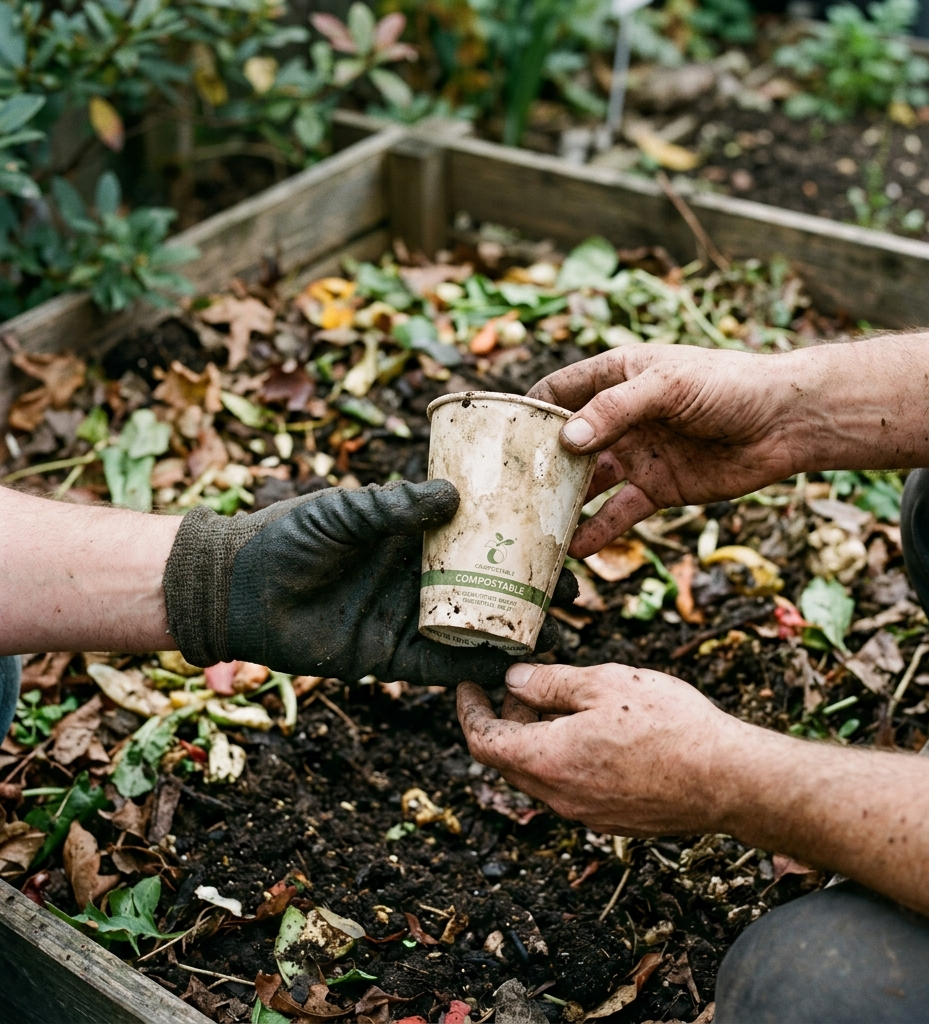
Imagine finishing a cup of coffee from a cup with a happy leaf logo and the word compostable. And then you put that cup into your compost bin feeling so proud of yourself, only to dig into your compost six months later to find your cup is still solid.
You didn’t do anything wrong. You trusted the label. The label mislead you.
Here lies the underlying problem within the packaging world right now and to fix it, you need to realize that there are compostable standards and the geographical location of where you live is extremely important when it comes to how those compostable standards apply.
Why a “Compostable” Label Means Almost Nothing on Its Own
The term “compostable” in connection with products is a conditional or potential statement, at best! A study done in 2023 in Science of the Total Environment, found about 40% of products listed as compostable/biodegradable in Europe contain some form of intentional misleading claims associated Therefore, the FTC has flagged similar issues with their Green Guides.
The reason why there is such a disparity between what products can be labelled compostable, is because there isn’t one universal standard that establishes what compostability is; therefore, each has its patchwork of regional standards which vary in criteria, testing protocols and enforcement structures.
The Big Three Standards You Should Know
Across the world, three certifications carry the most weight:
EN 13432 (Europe)
The EN 13432 certification has been established by the European Committee for Standardization and is regarded by many as the most extensive of the three. In addition to being required to agitate to a minimum of 90% biodegradability within 12 weeks of industrial composting, to qualify for this certification, products must also show that they leave no toxic residue behind. The certificate itself is verified through independent testing and offers a legally defendable label of (leaf) that must be displayed on the product. This certificate is awarded by an authorized organization such as DIN CERTCO or TÜV Austria, as well as by law in relation to the EU Single-Use Plastics Directive.
ASTM D6400 (United States)
The American equivalent of the EN 13432 certification is the ASTM D6400 certification. The ASTM D6400 certification is governed through ASTM International, and has similar criteria as to those of the EN 13432 certification; for ASTM D6400 to approve the certification of a product, the product must biodegrade by 60% within 180 days. Many people question the validity of systems in use for certified product testing, as conditions used in testing may be unrealistic when compared to real-life conditions of industrial composting facilities. Resource, Conservation and Recycling are paper published in 2022 that indicates that almost 66% of industrial composting facilities in the US will not accept biodegradable certified products from the personnel who are bringing them to their disposal sites due to a lack of infrastructure.
AS 4736 / AS 5810 (Australia)
It splits the conversation into two. Industrial composting and home composting. AS 5810 for home composting is notably stricter in some ways than its European peer, requiring biodegradation at ambient temperatures (around 20–30°C) much closer to what actually happens in a backyard bin.
The Infrastructure Gap
Even if a product perfectly meets EN 13432 or ASTM D6400, it only breaks down properly in a certified industrial composting facility where temperatures exceed 55°C and conditions are carefully controlled. According to the Ellen MacArthur Foundation’s 2024 Packaging Rethink report, fewer than 15% of municipalities globally have access to industrial composting that accepts packaging materials.
Europe leads adoption at around 68%, as shown in the chart above driven by EU policy mandates and extended producer responsibility (EPR) schemes in Germany, France, and the Netherlands. North America sits at 44%, with wide variation between states and provinces. Across much of Asia, Latin America, and Africa, formal compostable standards remain nascent or inconsistently enforced.
However, the market is not going to wait around. As the second graph below illustrates, the global compostable packaging market was worth around $8.1 billion in 2023, and by 2028, it is expected to have doubled its value to $14.5 billion (Grand View Research, 2024). There are going to be many leaf symbols and cups thrown into landfills.
The Home Composting Frontier
Home-composting has emerged as the most exciting new regulatory trend in the past three years. While industrial composting requires unique infrastructure, home-composting occurs naturally in your own yard (at lower and more variable temperatures) and does not require professional management.
Organizations such as TUV Austria (with its OK compost HOME certification) and the Home Compostable Coalition in the UK are working towards producing real home-compostable products. Research published by Wageningen University in 2023 found that out of all of the products currently certified as “compostable” under industrial standards, only 12% would actually break down through home composting. There is still a huge difference between what can be done and what needs to be done.
Frequently Asked Questions
Q: If a package says “compostable,” can I put it in my home compost bin?
It depends. While items that have been certified according to standards such as EN 13432 or ASTM D6400 are usually intended for industrial composting processes involving high temperatures, there are items that have been certified according to Australian standard AS 5810 that are suitable for home composting.
Q: Are compostable and biodegradable the same thing?
These are two very different terms, and confusing them may be considered one of the most common cases of greenwashing. While the term “biodegradable” is quite broad, meaning that something will decompose eventually, under any conditions and over any period of time, “compostable” implies a process of decomposition within certain conditions within a certain timeframe.
Q: Why don’t industrial composters just accept all certified compostable packaging?
It is due to the infrastructure and economics. Several facilities have discovered that some of the certified products actually break down over more than 12 weeks compared to what is required by the standard, hence producing contaminated batches of compost at the end of the process.