Every
harvest produces two streams: a product and its leftovers. The leftovers mostly
include straw, husk, shell, press cake, bagasse, etc. For most of the
industrial history these leftovers face a disposal problem with a price
attached to it.
A 2025
dataset published in Earth System Science Data showed that maize alone
leaves roughly 1.28 billion tonnes of field residue every year. Wheat leaves
about 1.25 billion tonnes, rice about 1.11 billion. Sugar mills discharge close
to 548.7 million tonnes of bagasse annually (Sileshi et al., 2025).
What’s
Inside a Straw?
Almost all
crop residue is lignocellulosic i.e. three polymers wound tightly together.
Cellulose:
It is the long
glucose chain that gives plant fibre its tensile strength.
Hemicellulose:
It is shorter,
branched sugar polymer that comes apart more easily.
Lignin: It is the rigid. Aromatic glue that
stiffens the cell wall and makes the whole assembly resistant to rot and
inconveniently resistant to composite.
A few
residues carry a fourth component. Rise takes up dissolved silicon from soil
water and deposits it in the husk, which is why rice husk behaves less like
wood and more like a mineral loaded composite.
Each
fraction serves a different function. The underlying principle is to
either isolate them individually or utilize them as a whole, based on the
intended end product.
Routes Out of the Field
·
Keep the fibre intact
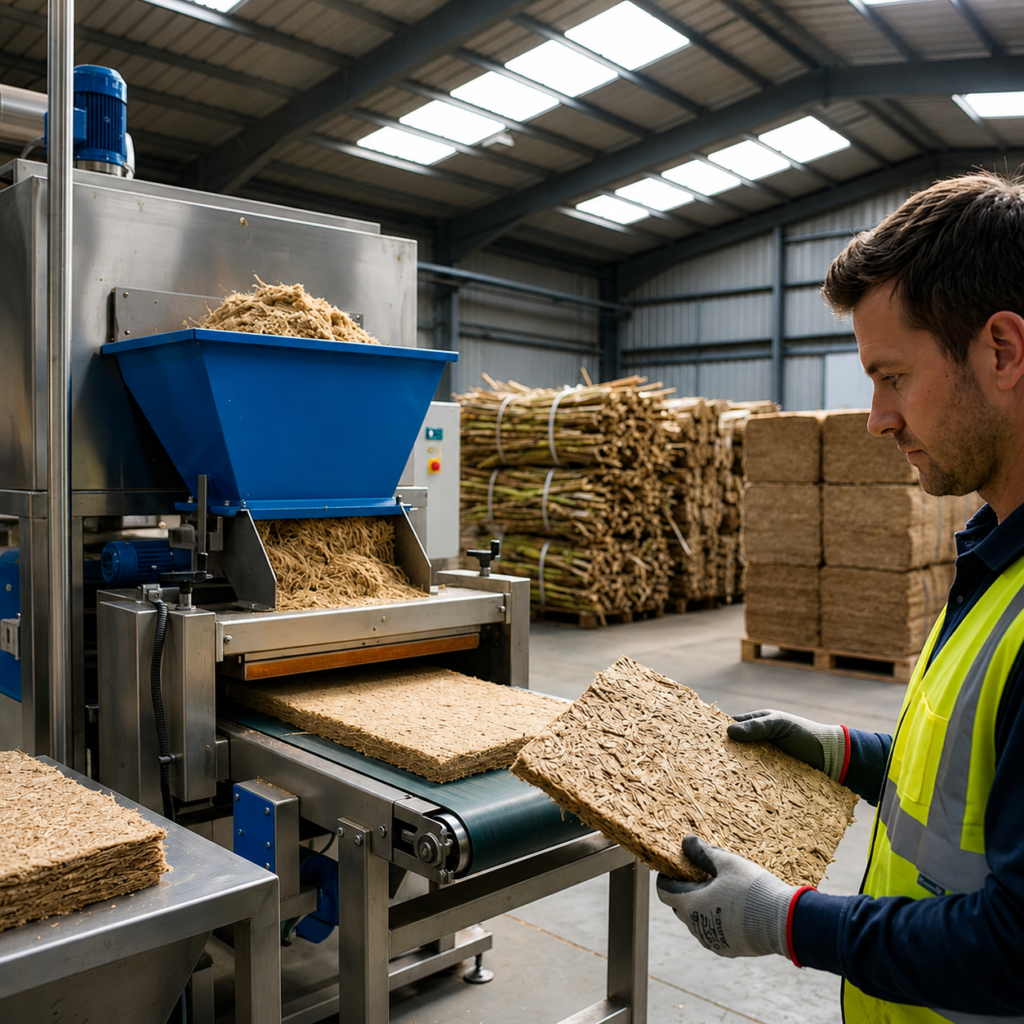
It is the simplest route. Chop the straw,
screen it, press it with a binder, and you’d have a structural panel. The
interesting constraint is the binder. Conventionally urea-formaldehyde resin is
used which is cheap, effective, and off-gasses formaldehyde.
In October 2025, the Fraunhofer
Institute for Wood Research WKI described a project called LowEPanel that
build particleboard adhesive entirely from biogenic raw materials; lignin
paired with hydroxymethylfurfural obtained by dehydrating sugar with the goal
of a formaldehyde-free bounded board. The work is funded by the German Federal
Ministry of Food and Agriculture through the agency FNR (Fraunhofer WKI, 2025).
In that route, lignin stops being a leftover from pulping and works as the
glue.
·
Burn and store the ash
Rice husk is a decent boiler fuel. But the ash is often worth more.
Researchers reporting in Silicon in 2025 gasified husk under controlled
conditions and then dissolved the ash, recovering amorphous silica at 96-00%
purity. The fly-ash fraction reached a specific surface area of 412.72 m²/g,
and the bottom-ash route gave the higher extraction yield at 86.66% by weight
(Wolgamudi et al., 2025).
Amorphous silica at that surface area is a
functional industrial material, used as a pozzolan in concrete, as reinforcing
filler in rubber, and as a catalyst support. A mill that previously paid to
dispose of ash ends up with two suitable outputs.
·
Break into sugars
Pretreat straw with heat, dilute acid or enzymes and the cellulose and
hemicellulose come apart into fermentable sugars. Those sugars feed everything
downstream: ethanol, organic acids, xylitol, polymers. This is also the most
expensive step in the chain, precisely because lignin does its protective job
so well.
·
Feed the sugars to a microbe
Once sugars are available, bacteria can turn them into plastic.
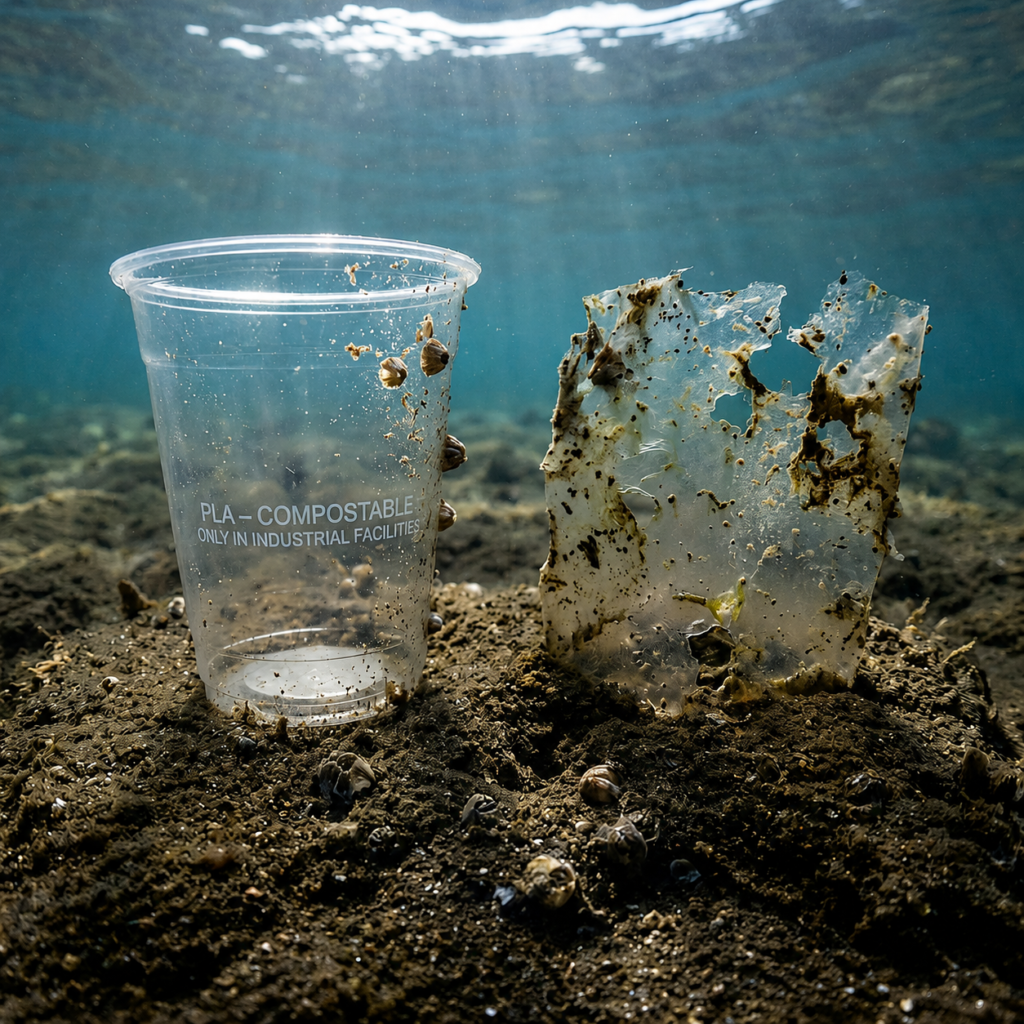
Polyhydroxyalkanoates (PHA) are polyesters that certain bacteria store
internally as carbon reserves, and they break down in soil and marine
conditions without needing an industrial composting facility.
A 2025 review in RSC Advances collected reported yields from
crop-residue hydrolysates. Cupriavidus necator DSM 545 grown on wheat
straw accumulated 80.1% PHA of cell dry weight at 12.1 g/L biomass. Bacillus
firmus NII 0830 grown on rice residue reached 89% (Chouhan & Tiwari, 2025).
Cost is the barrier. The same review placed PHA production at roughly
US$ 4,000-15,000 PER tonne against about US$ 1,250 per tonne for conventional
plastics, with feedstock alone accounting for 40 – 48% of PHA production cost
(Chouhan & Tiwari, 2025). That ratio explains the whole industrial interest
in residue.
·
Grow the material
Instead of relying on conventional binders,
straw is fed to a fungus and left for the mycelium to grow through and colonise
the entire block. Once the network has developed, the material is heat-treated
to kill the fungus. What remains is a solid structure held together by the
fungal mycelium itself, eliminating the need for synthetic resin.
A study published in Scientific Reports
in April 2026 compared five different substrates for mycelium-based insulation.
Wheat straw emerged as the best-performing substrate, achieving a thermal
conductivity of 0.031 W/m·K, which falls within the same range as mineral wool.
In comparison, ash-wood chips recorded a higher thermal conductivity of 0.048
W/m·K. The environmental advantage was even more striking: the straw-based
composite had a cradle-to-gate global warming potential of just 4.04 kg CO₂-eq
per functional unit, compared with 99–100.1 kg CO₂-eq for expanded polystyrene,
polyurethane, and glass wool (Wildman et al., 2026).
How Big
Is This Sector
It is
growing fast!
European
Bioplastics reported global bio-based plastics production capacity of 2.31
million tonnes in 2025, projected to roughly double to about 4.69 million
tonnes by 2030. That is around 0.5% of the 431 million tonnes of plastic the
world makes each year (European Bioplastics, 2025).
Panels,
silica and biochar sit outside that figure and are commercially further along,
because they compete against cheaper incumbents on performance rather than on
chemistry.
Logistics
in Play
Straw is
bulky, seasonal and wet. It needs to be dried to be worth every tonne at the
point if collection.
A
processing plant needs year-round supply from a crop that arrives in a
three-week window, which means baling, drying, covered storage, and a
purchasing relationship with hundreds of individual farmers. Several
technically sound biorefineries have failed on that arithmetic rather than on
yield.
The
projects that work tend to sit inside an existing agro-industrial site (sugar
mill, rice mill, oil palm complex, etc) where the residue is already
aggregated, already dry enough, and already someone’s problem.
Frequently
Asked Questions
Are
bio-based materials the same as biodegradable materials?
No.
Bio-based means what it is made from or rather say where the carbon came from;
biodegradable describes what will happen at the end-of-life of the product. For
example, bio-based polyethylene is made from sugarcane, it is chemically
identical to fossil polyethylene and does not biodegrade. PHA is both bio-based
and biodegradable. Always check which claim is being made.
Does
diverting crop residue to industry harm soil or compete with food?
It can, particularly when residue removal is carried out
without considering the soil’s requirements. Leaving a portion of the residue
in the field helps preserve soil organic carbon, retain moisture, and maintain
soil structure. For this reason, credible projects focus on surplus residue
which is the amount remaining after meeting agronomic needs and existing uses rather
than treating all generated residue as available feedstock.
Since the material is a byproduct rather than a dedicated
crop, its use does not directly compete with land needed for food production.
However, it may still compete with established uses of the residue, such as
livestock fodder or household fuel.
Why is
rice husk treated so differently from other crop residues?
The key reason lies in its high silicon content. Rice plants
absorb dissolved silicon from the soil and accumulate it in the husk. When the
husk is burned, much of this silicon remains as silica-rich ash rather than
conventional mineral ash. As a result, rice husk is unusual among agricultural
residues because its most valuable component is not the carbon, but the
inorganic fraction particularly the silica left behind after combustion.
Reference
Chouhan, A., & Tiwari, A. (2025). Production of
polyhydroxyalkanoate (PHA) biopolymer from crop residue using bacteria as an
alternative to plastics: A review. RSC Advances, 15(15), 11845. https://doi.org/10.1039/D4RA08505A
European Bioplastics. (2025, December 2). Bioplastics
market development update 2025. https://www.european-bioplastics.org/bioplastics-market-development-update-2025/
Fraunhofer Institute for Wood Research,
Wilhelm-Klauditz-Institut WKI. (2025, October 2). Turning residual materials
into resources: Bio-based adhesives for wood-based materials [Press
release]. https://www.wki.fraunhofer.de/en/press-media/2025/press-release_2025-11_bio-based-adhesives-for-wood-based-materials.html
Molgamudi, S. P., Thogaru, S., & Sutar, S. M. (2025).
High-purity silica extraction from rice husk ash via optimized biomass
gasification: A comparative study of fly and bottom ash. Silicon, 17(17),
4001–4012. https://doi.org/10.1007/s12633-025-03465-7
Sileshi, G. W., Barrios, E., Lehmann, J., & Tubiello, F.
N. (2025). An organic matter database (OMD): Consolidating global residue data
from agriculture, fisheries, forestry and related industries. Earth System
Science Data, 17(1), 369–391. https://doi.org/10.5194/essd-17-369-2025
Wildman, J., Cascione, V., Henk, D., & Shea, A. (2026).
Comparing substrates for mycelium-based composite insulation materials with
thermal and environmental assessment. Scientific Reports, 16, Article
17466. https://doi.org/10.1038/s41598-026-48045-w