Most of the shoppers read a claim as a guarantee. In
practice, a claim can rest on any one of the three foundations including
self-declaration, third-party test report or a full certification.
Self-declaration is when a brand tests its own product, or
simply asserts a benefit and prints it. Brands just confirm that the testing
happened and they say mostly nothing else about it like what was measured, who
measured it, or whether anything was passed. Phrases like “dermatologically
tested.”
A third-party test report is an outside lab tested one batch
report which is tested once and issued as a report. Wordings such as “meets” or
“tested” a standard usually signals this. Nobody checks the next batch.
Full certification is obtained when an accredited body tests
the product. They audit the factory and keep on auditing it, which is what buys
the right to display a certification mark. UL Listed, NSF certified, and CE
marking under a notified body all work this way.
A certificate certifies performance under the
conditions the standard specifies.
Italy’s competition authority made this concrete in November
2020, fining Apple €10 million over iPhone water-resistance advertising. The
regulator’s objection was not that the IP ratings were false. It was that the
ads never explained that the rating came from “specific and controlled
laboratory tests with the use of static and pure water, and not under normal
conditions of use” while Apple’s own warranty excluded liquid damage (Euronews,
2020).
Pool water is chlorinated, seawater corrodes, and a phone in
daily use has been dropped, warmed, and charged a thousand times while its
gaskets aged. The IEC 60529 test involves none of that. Both statements can be
true at once: the phone passed IP68, and the phone died in the pool.
Bio-based, Biodegradable and Compostables
These words are not synonyms even though they are often
treated as the same.
Bio-based only describes where a material came from but
nothing about its end of life. The word biodegradable doesn’t tell the timeline
of the material getting biodegraded. Compostable is different because it is
anchored to measurable standards, chiefly ASTM D6400 and D6868 in North America
and EN 13432 in Europe, requiring a set percentage of breakdown within a set
window under set conditions.
Despite the clarity on paper, the European Environment
Agency (2021) notes that only about one percent of plastics on the global
market currently qualify as bio-based, compostable, or biodegradable under any
recognized standard, even as marketing use of those words has grown far faster
than the certified supply behind them.
What Certification Requires
Genuine compostable certification is not just self-declared.
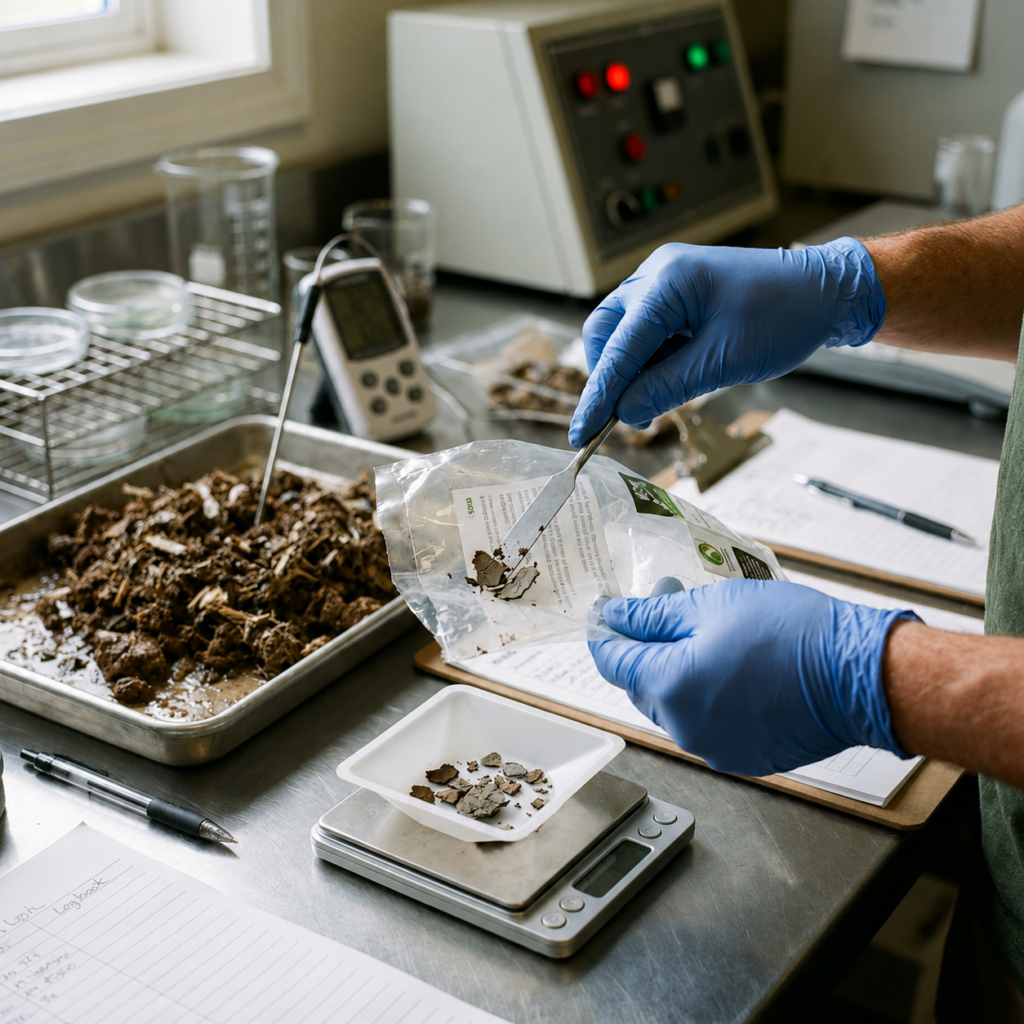
ASTM D6400 requires materials to break into pieces smaller
than 2 mm and biodegrade at least 90% within about 180 days under industrial
composting conditions. They must also pass eco-toxicity tests.
BPI checks these requirements before giving its
certification. TUV Austria provides OK compost INDUSTRIAL and OK compost HOME
marks. The Compost Manufacturing Alliance also tests products in real
composting facilities. Since lab tests may not fully represent real composting
conditions, ASTM developed D8618 and D8619 for field testing.
What Data Shows
Independent testing shows that many products labelled
“compostable” may not actually meet certification standards. One study found
that about 38% of compostable products in the non-food B2B sector failed to
break down properly under industrial composting conditions.
Another test of 112 home-compostable packaging samples found
that only about 29% passed the required standard in real composting conditions.
Testing also found that around 43% of some compostable mailers and produce bags
contained plastic layers that can resist biodegradation.
Even certified compostable materials can face problems in
real composting facilities. Some may leave plastic residues after composting,
and not all composting facilities accept them. Therefore, certification proves
that a product passed specific tests, but it does not guarantee that it will
break down successfully in every real-world composting environment.
Certification is scoped to a specific environment and that
scope rarely survives translation into marketing copy. For example, a product
certified under ASTM D6400 is tested under high heat and active microbes found
in industrial composting, which are usually not present in home composting,
landfills, or oceans. This is why certifications like OK compost INDUSTRIAL and
OK compost HOME are different. A product may be properly certified for one
environment but may not break down in another. The main problem is often not
false certification, but marketing that does not clearly explain the conditions
needed for composting.
Regulations are Tightening
Governments have been regulating misleading biodegradable
claims for years.
In 2013, the FTC took action against companies such as ECM
Biofilms for claiming that additive-treated plastics were biodegradable without
enough scientific evidence.
The issue still exists today. Washington State now bans
terms like “biodegradable,” “degradable,” and “decomposable” for plastic
products unless they meet specific requirements, while allowing properly
certified and labelled “compostable” products. California also limits
unqualified biodegradable claims. The EU is also moving toward stricter rules
on biodegradable claims, encouraging manufacturers to use certified and
scientifically supported terms instead.
How to Read a Label
·
Consumers can avoid misleading claims by
following a few simple steps:
·
Look for recognised standards such as ASTM D6400,
D6868, or EN 13432 instead of just the word “biodegradable.”
·
Check for certification marks from BPI, TUV
Austria, or CMA.
·
Be careful with biodegradable claims that do not
mention a specific time or environment.
Also remember that industrial compostable does not mean home
compostable, and neither means the product will break down in landfills or
oceans. When unsure, check the certifier’s public product database. If the
claim cannot be verified, it may simply be green marketing.
The Verdict
This does not mean that compostable materials are a scam or
that certification is useless. In fact, certification is important for checking
whether environmental claims are genuine. The main problem is when companies
use the credibility of certification without actually meeting the required
standards, or when certified products are marketed as if they work in every
environment. This gap can be reduced through clearer labelling, stricter
regulations, and consumers checking the standard behind the claim.
Frequently Asked Questions
Is biodegradable the same thing as compostable?
No. Biodegradable means a material can eventually break
down, but it does not specify how fast, where, or whether it leaves harmful
residues. Therefore, regulators like the FTC are cautious about such claims. Compostable,
on the other hand, follows specific standards such as ASTM D6400, D6868, or EN
13432. These standards require the material to break down by a certain amount
within a specific time under defined composting conditions.
Which certification marks are actually trustworthy?
BPI certification and TUV Austria’s OK compost marks in the
United States and Europe, alongside field validation from the Compost
Manufacturing Alliance are the most widely recognized third-party verifications
tied to ASTM and EN standards.
Can a company get in legal trouble for a false
biodegradable or compostable claim?
Yes. The FTC has taken action against unsupported
biodegradable claims since 2013 under its Green Guides. States like Washington
and California also have rules limiting the terms companies can use on
packaging. These rules generally require compostable products to be properly
certified and labelled.
References
Biodegradable Products Institute. (2026). Certified
compostable products: Science, standards, and the facts that matter. https://bpiworld.org/blog/certified-compostable-products-science-standards-and-the-facts-that-matter
Börner, T., & Zinn, M. (2024). Key challenges in the
advancement and industrialization of biobased and biodegradable plastics: A
value chain overarching perspective. Frontiers in Bioengineering and
Biotechnology, 12, Article 1406278. https://doi.org/10.3389/fbioe.2024.1406278
Chong, Z. K., Hofmann, A., Haye, M., Wilson, S., Sohoo, I.,
Alassali, A., Kuchta, K., Karamanlioglu, M., & Hayes, D. G. (2024).
Lab-scale and full-scale industrial composting of biodegradable plastic blends
for packaging. Open Research Europe, 4, Article 14893. https://doi.org/10.12688/openreseurope.14893.3
European Environment Agency. (2021). Biodegradable and
compostable plastics: Challenges and opportunities. https://www.eea.europa.eu/publications/biodegradable-and-compostable-plastics
Federal Trade Commission. (2013, October 29). FTC cracks
down on misleading and unsubstantiated environmental marketing claims. https://www.ftc.gov/news-events/news/press-releases/2013/10/ftc-cracks-down-misleading-unsubstantiated-environmental-marketing-claims
Nantbiorenewables. (2026). Spot greenwashing: Compostable
packaging guide. https://nantbiorenewables.com/news/how-to-protect-against-greenwashing-claims/
Toriseg Group. (2026, April 28). Compostable packaging
[truth vs. greenwash]: How to choose truly sustainable B2B solutions. https://www.torisegroup.com/blog/Compostable-packaging-truth-vs-greenwash-how-to-choose-truly-sustainable-B2B-solutions_b23158
Washington State Department of Ecology. (n.d.). Compostable
product labeling requirements. https://ecology.wa.gov/waste-toxics/reducing-recycling-waste/plastics/compost-labeling