A pulp can be 96% pure and still fail in production because
purity tells you what’s there but viscosity tells you how it would perform.
In the world of cellulose-based materials, purity gets all
the attention. A pulp advertised at 96% alpha-cellulose sounds like the gold
standard, and in marketing terms, it usually is treated that way.
Dissolving pulp, the high-purity cellulose used to make
viscose, lyocell, and cellulose derivatives, is defined by several properties
working together, including high alpha-cellulose content, low hemicellulose,
high reactivity, and appropriate viscosity, with purity, reactivity, and
viscosity considered the three most critical (Chen et al., 2016).
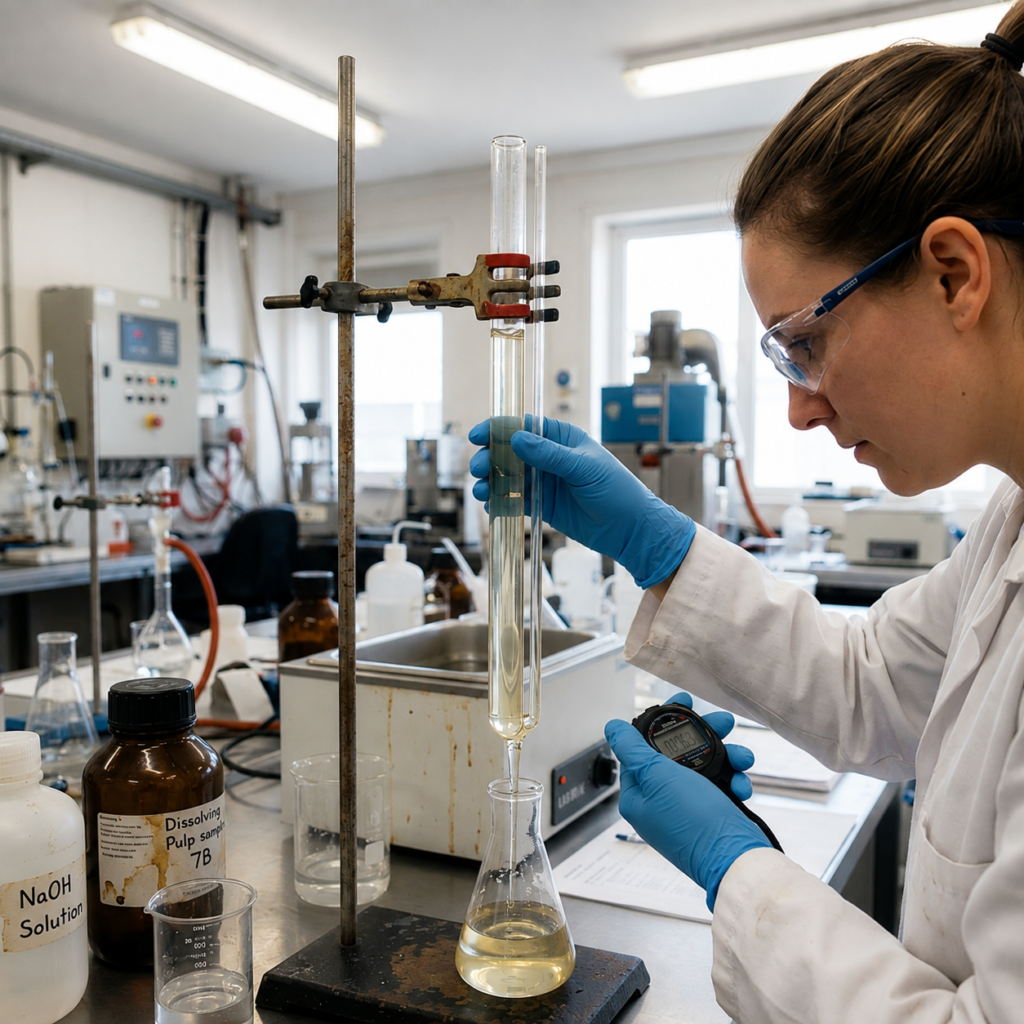
Viscosity, in this context, is really a proxy for the degree
of polymerization, or DP, meaning the average length of the cellulose polymer
chains. Two pulps can share nearly identical purity numbers and still behave
completely differently in processing, because one has long, intact cellulose
chains and the other has been degraded into shorter fragments during pulping or
bleaching.
That difference shows up immediately downstream. Chains that
are too long make the dissolving process slow and difficult to filter cleanly.
Chains that are too short produce weak, brittle fiber that fails under tension.
Manufacturers aren’t chasing the highest viscosity possible, they’re chasing
the right, narrow, consistent range for the product they’re making.
What the Research Shows
A 2021 study on enzymatic pulp treatment demonstrated that
as cellulase enzyme dosage increased, pulp viscosity dropped in a controlled,
dose-dependent way, and the researchers noted that a precise reduction in
viscosity is advantageous for producing better-performing viscose rayon and
maintaining fiber strength, rather than degrading it (Kaur et al., 2021).
A 2023 study on pre-hydrolysis kraft pulping reported
concrete production figures, achieving a pulp viscosity of 812 cm3/g alongside
a kappa number of 9.5, illustrating how viscosity and residual lignin content
are tracked side by side as separate, equally important quality metrics in real
manufacturing runs (Cunha & Simões, 2023).
Reactivity testing tells the same story from another angle.
Dissolving pulps are commonly required to react with over 90% efficiency in the
standard Fock reactivity test used to predict how well a pulp will convert into
viscose, a threshold that depends on fiber accessibility and chain length as
much as on chemical purity alone.
Why This Isn’t Just an Industrial Footnote
The same principle holds outside papermaking. In
pharmaceutical manufacturing, cellulose ethers like hydroxypropyl
methylcellulose are sorted into specific viscosity grades because that number,
not the chemical purity of the powder, predicts how a tablet coating will
dissolve, how a gel will spread, or how quickly a drug will release into the
body. A cellulose ether can be chemically pure and still be the wrong grade
entirely for its intended job, because viscosity reflects molecular weight and
structural behavior that purity testing does not capture.
In short, purity is a snapshot of composition. Viscosity is
a window into performance. An industry that only screens for one is only seeing
half the material.
Takeaway for Manufacturers and Buyers
If you’re sourcing cellulose for fiber, film, or
pharmaceutical use, treat purity as the entry ticket, not the finish line. Ask
for the viscosity or DP range, the reactivity value if it’s a dissolving-grade
pulp, and how consistent that number stays across production batches. A
supplier who can only quote alpha-cellulose percentage is telling you half of
what you need to know.
Frequently Asked Questions
What does cellulose viscosity actually measure?
It measures how thick a cellulose solution is under standard
test conditions, which reflects the average length of the cellulose polymer
chains, known as the degree of polymerization. Longer chains generally mean
higher viscosity.
Can a highly pure cellulose pulp still fail quality
standards?
Yes. A pulp can have excellent alpha-cellulose content and
still be unsuitable for its intended use if its viscosity or reactivity falls
outside the required range for that process.
Why does viscosity matter so much for viscose or lyocell
fiber production?
Because chain length directly affects how the pulp
dissolves, how the resulting fiber can be spun, and how strong the final fiber
turns out. Chains that are too short weaken the fiber, and chains that are too
long make processing difficult.
Is higher viscosity always better?
No. Manufacturers target a specific, narrow viscosity range
suited to their process rather than maximizing it, since both excessively high
and excessively low viscosity create processing problems.
References
Chen, C., Duan, C., Li, J., Liu, Y., Ma, X., Zheng, L.,
Stavik, J., & Ni, Y. (2016). Cellulose (dissolving pulp) manufacturing
processes and properties: A mini-review. BioResources, 11(2), 5553-5564. https://doi.org/10.15376/biores.11.2.Chen
Cunha, A. E. P., & Simões, R. M. S. (2023). Dissolving
kraft pulp production and xylooligosaccharide coproduction: Effect of
pre-hydrolysis conditions. ACS Omega, 8(15), 13626-13638. https://doi.org/10.1021/acsomega.2c07594
Kaur, P., Bhardwaj, N. K., & Sharma, J. (2021). A study elucidating the relation between cellulose dissolution and crystallinity after cellulase treatment at different doses. 3 Biotech, 11, 371. https://doi.org/10.1007/s13205-021-02920-7