As of 2024, the most common type of bioplastic produced today, PLA (polylactic acid), makes up 37% of bioplastic production capacity around the world.
When it comes to composting PLA, it is only safe to do so in a controlled industrial composting environment, where conditions must be maintained at approximately 58°C, with relative humidity levels of approximately 80%, and where there is a specific population of microorganisms/decomposers present (e.g., fungi and bacteria). There are no controlled composting conditions in the ocean, as the average ocean thermocline temperature the world over is only 3.9°C, and in most areas of Europe, the mean surface water temperature (excluding heat waves) is at or below 20°C.
A recent landmark study reported in the journal Frontiers in Marine Science tested five of the largest types of bioplastics (including PLA) at ecologically realistic seawater temperatures between 3°C and 20°C. The researchers found that, when temperatures remained below 20°C, the rate of bioplastic enzymatic hydrolysis was nearly non-existent.
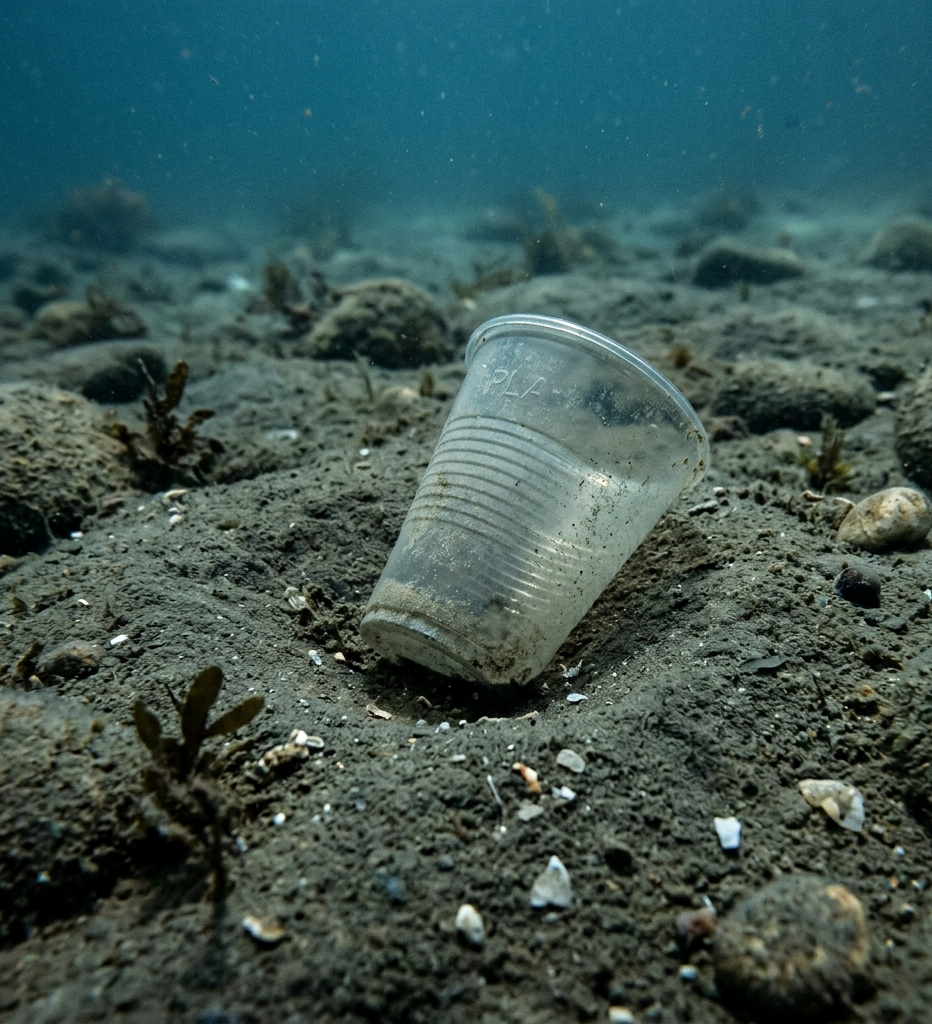
Therefore, if you toss your PLA cup overboard in the North Atlantic Ocean, it is essentially the same as tossing a traditional plastic bottle because both will likely remain in plastic forms for thousands of years.
Most of the bioplastics are denser than water with densities between 1.2 and 1.5 g/cm³ meaning they sink to the seafloor, where temperatures are even colder and oxygen is even scarcer. Down there, PLA undergoes surface erosion rather than the full degradation we hope for, slowly shedding into smaller and smaller particles.
Microplastic Fragments
A new ScienceDirect study conducted in 2025 on PLA as it relates to marine sediment showed that bioplastics do not disappear but rather just become smaller in size (they break into micro and nano plastics). The range of concentrations measured for PLA microplastics in reservoir sediment were 53.5 to 491 nanograms per gram dry weight of sediment, with the presence of PLA microplastics found to be even deeper than 20 cm.
These fragments do not remain static. A 2024 review article published in the journal Trends in Analytical Chemistry indicated that there are many sediments containing biodegradable microplastics that are originating from PLA, PHA’s, and PBS’s that are present in waste water, freshwater and marine environments with concentrations ranging between 0.054 and 180 μg/L. Also, researchers found that as biodegradable microplastics degrade over time, their toxicity can increase due primarily to the addition of chemical additive and metabolic intermediates into the water column.
A study published in the journal Water in December 2024 quantified leaching from compostable plastics exposed to coastal marine environments. The study recorded plasticizers leaching from compostable plastics between 264 and 342 micrograms of leachate per gram of plastic depending on the amount of time exposed to light. Another biopolymer, PHB (Poly-3-hydroxyburtarate), is also known to have a long half-life (up to eight months) in marine environments, even when favorable conditions exist for degradation.
So, Is There Any Hope?
There is good news when it comes to plastics!
In October 2024, a new type of biodegradable plastic foam that can break down faster than any other type of plastic was discovered by scientists. It is called cellulose diacetate foam. In July 2025 Japanese researchers at Shinshu University showed a new type of plastic called LAHB (a long-chain variant of PHA), can also decompose in deep oceanic waters where it is hard to break down because of low temperatures, high pressure and a lack of nutrients. Microorganisms can evolve over time and learn to consume new products that humans make.
Nereid Biomaterials’ team at the University of Rochester (with $5 million in funding from NSF) is currently working on developing bioplastics that only decompose in marine environments, with the added benefit that they contain the same microorganisms that can decompose them. This may sound like it is from the future (science fiction) but the project is Phase 2, and they currently have a working prototype.
The sad truth is that most of the bioplastics on the market may not be appropriate for disposal in oceans today. The current certification systems were not based on anything to be done in seawater, therefore, there is almost no guarantee of what will happen in seawater 4° at 3,000 metres deep to materials labelled “compostable” or “biodegradable.”
Frequently asked questions
Q: Are all bioplastics the same when it comes to ocean degradation?
Absolutely not. PHB and PHBV, which stand for polyhydroxybutyrates, break down much quicker compared to PLA within just 6 to 8 months in favorable circumstances. In contrast, PLA, the most manufactured bioplastic, can last up to decades within cold ocean waters.
Q: Does “compostable” on a product mean it’s safe if it enters the ocean?
No. Compostability testing standards such as EN 13432 and ASTM D6400 rely on the industrial process of composting at 58°C in the presence of particular bacteria. This process would not take place in the ocean since its temperature and chemical composition differ significantly from those of industrial composting.
Q: Do bioplastic microplastics cause harm like conventional microplastics?
Yes, and in certain ways, this damage could even prove to be more serious. The chemicals used in the production of bioplastics tend to break down, releasing toxic substances that could affect aquatic life forms. In a 2024 study, it was revealed that the toxicity levels of biodegradable microplastics increased after breaking down.