The word “biodegradable” has a serious problem: it tells you what a material can do, not what it will do. Those are very different things, and the gap between them is where most eco-friendly claims fall apart.
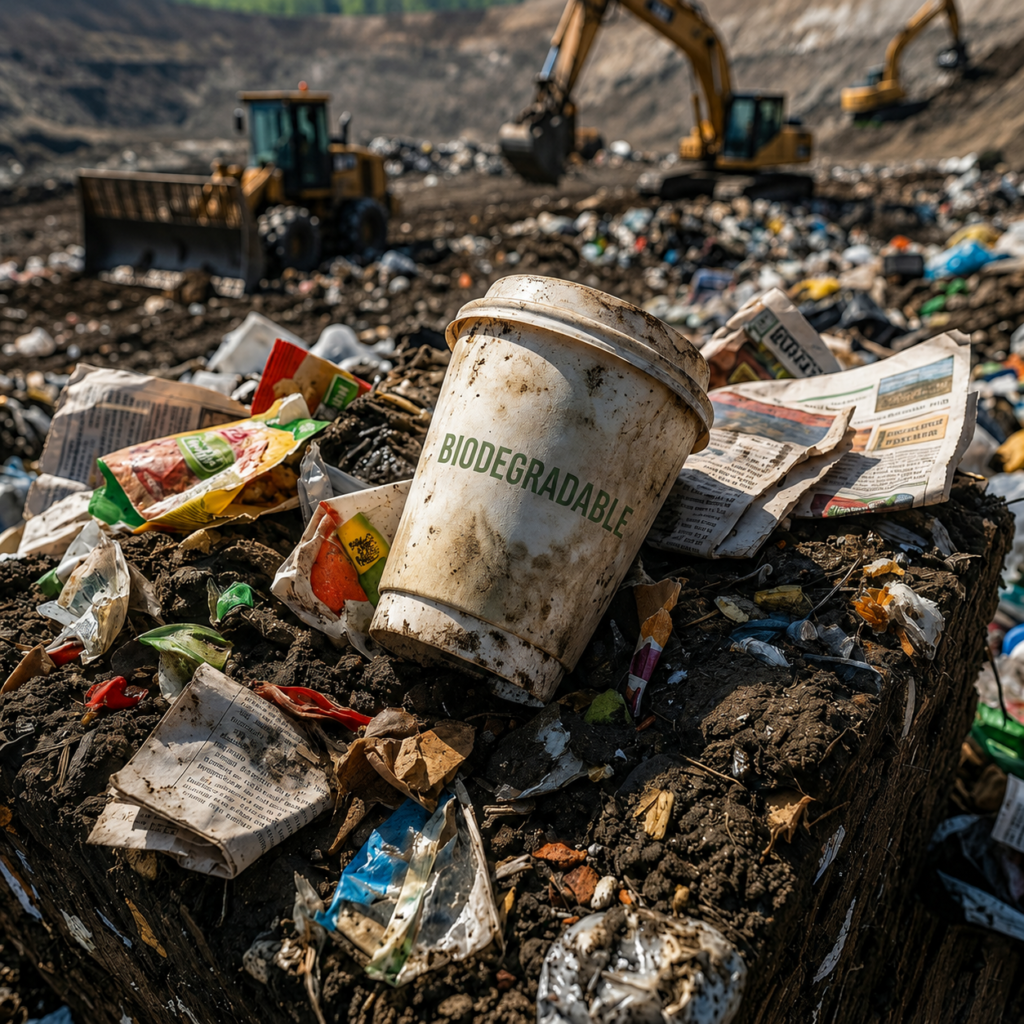
Picture this: you buy a coffee in a cup labelled “biodegradable,” toss it in the bin, and move on. The label did its job you feel like you made a responsible choice. The problem is the cup probably didn’t do its job. Depending on where you live, that cup is almost certainly sitting in a landfill right now, not decomposing. In fact, it may be making things slightly worse.
This isn’t cynicism. It’s what the research shows. And understanding why matters because the same logic applies to biodegradable cutlery, food packaging, bin bags, and dozens of other products people are paying a premium for in good faith.
What Actually Happens in a Landfill
Biodegradable materials need three things to break down: oxygen, moisture, and microbial activity. Modern landfills are engineered to prevent all three. They’re sealed, compressed, and designed to stop leakage which makes them excellent at one thing: preserving everything you put in them.
Researchers at North Carolina State University tested this directly. They placed biodegradable cups and cutlery into a landfill simulator that reproduced real burial conditions. The materials didn’t cleanly decompose. Instead, as they began to break down in the low-oxygen environment, they produced methane a greenhouse gas roughly 80 times more potent than CO₂ over a 20-year period. If that methane isn’t captured (and in many landfills, it isn’t), a product sold as eco-friendly ends up being a net negative for the climate.
The core problem: Excavations of old landfill sites have found newspapers from the 1970s still legible, food scraps from decades ago still identifiable, and biodegradable plastics showing no meaningful degradation advantage over conventional plastic. A landfill doesn’t process material it stores it.
The takeaway isn’t that biodegradable materials are a scam. It’s that a material’s ability to decompose only matters if the conditions for decomposition actually exist where it ends up. And for most consumers in most cities, those conditions don’t exist at the end of a bin bag.
Why “Biodegradable” Is a Nearly Meaningless Label
The word has no universally enforced time limit. Technically, everything biodegrades eventually conventional plastic included, over hundreds of years. “Biodegradable” on a label tells you nothing about whether a product will decompose in a year or a century, or under what conditions.
The U.S. Federal Trade Commission addressed this gap directly in its Green Guides. The FTC’s position is that a product should only be labelled biodegradable if it completely breaks down within one year under the disposal conditions consumers typically use. For most people, that disposal condition is a landfill and almost no biodegradable product on the market meets this standard in landfill conditions. The distinction between “biodegradable” and “compostable” matters here. Compostable materials must break down into non-toxic residues within a specific timeframe under defined conditions it’s a stricter standard. But compostable products still require industrial composting facilities to work as intended. If your city doesn’t have one, a certified compostable cup faces the same problem as any other biodegradable material in a landfill.
The Certification Gap: What Labels Actually Tell You
Not all certification claims are equal. Here’s what the main ones actually mean and what they require:
| Certification | What it means | Where it applies |
|---|---|---|
| ASTM D6400 | Must biodegrade in an industrial composting facility within 180 days, leaving no toxic residue | Industrial composting only |
| OK Compost INDUSTRIAL | European equivalent to ASTM D6400 — verified compostability at high-temperature industrial facilities | Industrial composting only |
| OK Compost HOME | Must decompose in home composting conditions (lower temperature, longer timeframe). A genuinely higher bar. | Home composting bins |
| BPI Certified | US-based certification confirming compostability — requires ASTM D6400 or D6868 compliance | Industrial composting only |
| “Plant-based” / “Bio-based” | Describes the origin of the material (e.g. made from corn starch), not how it breaks down. Means nothing about end-of-life behavior. | N/A — not a disposal claim |
The practical implication: most certifications only work if industrial composting infrastructure exists at your location. Before assuming a certified product is delivering its environmental benefit, it’s worth checking whether your municipality actually has an industrial composting programme that accepts food-contact packaging.
How Better-Designed Products Actually Work
In October 2023, an industry initiative called the Compostable by Design Platform backed by resin manufacturers, brands, waste handlers, and certifiers published design guidelines for Europe specifically aimed at this problem. Their approach is instructive.
The core idea: sustainability isn’t a material property, it’s a system property. A material is only as sustainable as the infrastructure that processes it at end-of-life. This means good packaging design starts with a question where will this actually be disposed? and works backward from that answer.
Design for the real disposal route
A product destined for street bins in cities without composting facilities shouldn’t be designed for industrial composting. It should either use materials compatible with landfill (minimizing additives that generate methane) or be designed for reuse so it avoids disposal entirely.
Keep material flows separate
Circular design increasingly separates biological materials (designed to decompose safely) from technical materials (designed for long-term reuse or recycling). Mixing them undermines both streams. A compostable cup with a conventional plastic lid can contaminate an entire batch of compost, rendering the whole lot unusable.
Design for disassembly
Products designed to be easily taken apart at end-of-life allow each component to enter the right waste stream. One non-compostable component in an otherwise compostable product isn’t a minor detail it’s a system failure
The systems point: The future of sustainable packaging is less about inventing better materials and more about matching materials to the actual infrastructure that exists. A technically sophisticated compostable resin in a city with no composting facility is just expensive landfill..
A Practical Buying Guide: What to Actually Look For
- Look for specific certifications, not the word “biodegradable” alone. ASTM D6400, OK Compost INDUSTRIAL, OK Compost HOME, or BPI are the ones that carry real verification behind them.
- Check whether your local authority runs an industrial composting programme that accepts food-contact packaging. Most cities in the UK, US, and India do not — which means most compostable products end up in landfill regardless of their certification.
- Avoid mixed-material packaging where you can. A compostable body with a conventional plastic window or lining is a contamination risk for both composting and recycling streams.
- Don’t let “plant-based” be your deciding factor. A material derived from corn starch can still behave like conventional plastic in a landfill. Origin and end-of-life are separate questions.
- Reusable beats compostable beats conventional disposable in that order. A reusable cup used 50 times has a lower per-use footprint than any single-use alternative, biodegradable or not.
The Honest Summary
Biodegradable and compostable materials are not inherently bad — but the labels are widely misused, and the infrastructure needed to make them work is far less common than the marketing implies. Most of these products, in most places, end up in landfill. In landfill conditions, they don’t deliver the environmental benefit their labels promise, and some generate methane as they partially break down.
The gap isn’t mainly a materials problem. It’s a systems problem — a mismatch between what products claim on the label and what actually happens to them in the real waste infrastructure most people use. Until that mismatch is fixed at scale, the most reliable sustainable choice is still the same one it’s always been: buy less, use longer, dispose thoughtfully.
The next time you see a biodegradable label, the right question isn’t “is this eco-friendly?” It’s: “does my city have the infrastructure to make this eco-friendly?” That second question has a much harder answer but it’s the honest one.
Frequently Asked Questions
Does “biodegradable” mean a product will break down in a landfill?
No. Landfills are designed to be dry and airless to prevent leakage — the opposite of what biodegradable materials need to decompose. In these conditions, biodegradable products often degrade no faster than conventional plastic, and can release methane as they partially break down.
What’s the difference between biodegradable and compostable?
Biodegradable means a material can be broken down by living organisms, with no defined timeframe. Compostable means it must break down completely into non-toxic components within a specific time under defined conditions — a stricter standard. But compostable products still require industrial composting facilities to achieve this. Neither label guarantees environmental benefit in a landfill.
What certifications should I actually look for?
ASTM D6400, OK Compost INDUSTRIAL, OK Compost HOME, and BPI are the certifications backed by independent testing. They confirm the material will compost under specified conditions. “Plant-based,” “bio-based,” and unqualified “biodegradable” claims carry no verified end-of-life standard.
Are compostable products always better than conventional plastic?
Only if processed in a composting facility. In a landfill, they face the same conditions as conventional plastic — and in some cases generate more methane as they partially break down. Whether they’re better depends entirely on local waste infrastructure, not just the material itself.
Can a product be “plant-based” and still behave like plastic?
Yes. Many plant-based plastics (PLA, for example) are derived from corn starch but require industrial composting temperatures — around 60°C — to fully break down. At ambient temperatures in a landfill or home compost bin, they behave similarly to conventional plastic. Origin and end-of-life are separate properties.
How do I find out if my city has industrial composting?
Search for your local authority’s waste management page and look for food waste collection or organic waste programmes. In India, check with your municipal corporation. In the UK, check your council’s recycling guide. In the US, the Find a Composter tool at findacomposter.com can help locate nearby facilities.