The global beauty industry pumps out 120 billion units of packaging every year. Now, under pressure from regulators and Gen Z alike, it’s racing to reinvent the bottle itself.
Serums, cleansers, SPFs, toners, moisturisers. Nearly all of them are encased in plastic with pretty bottles that can’t be recycled because they’re made of three different materials bonded together, pump dispensers with metal springs that contaminate the whole unit.
95% of cosmetic packaging ends up in landfills after just one use, while 9% of all plastic generated has ever been recycled. While the cosmetics industry spends decades perfecting your skin, it also manufactures some of the most enduring forms of pollution.
The Bar Is Back
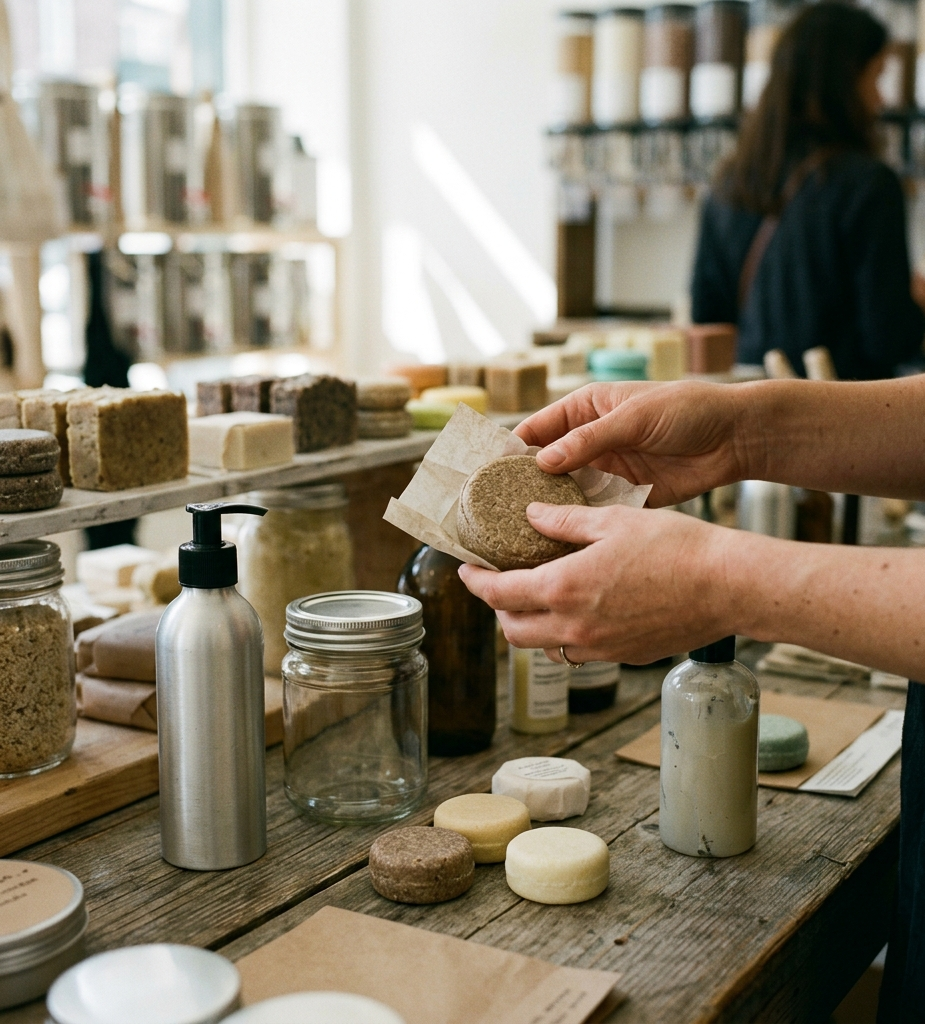
Lush Cosmetics figured this out over 25 years ago. A shampoo is majority water. If you remove the water, you remove the bottle. Their solid shampoo bars were dense, concentrated and wrapped in paper or nothing at all but they were initially met with puzzled stares.
“People didn’t understand how to use it,” recalls Lush’s communications team.
Today, their customers returned nearly 820,000 packaging items in the UK in FY24, amounting to nearly 20 tonnes of returned plastic.
Solid beauty products like shampoo bars, conditioner bars, cleansing balms, solid serums save approximately 500ml of water per unit compared to liquid equivalents. That’s water saved in formulation, water saved in weight during shipping, and emissions saved along the whole supply chain. Brands like Brixy, launched in 2022, have already displaced over 200,000 plastic bottles through bar formats alone.
“A single shampoo bar replaces an average of three plastic bottles. A single conditioner bar, another three.”
~ National Geographic
Refill 2.0
In Japan, the refillable packaging market was worth $237 million in 2024, where consumers used to routinely bring pouches to refill their skincare bottles.
And in the rest of the world?
Just $152 million, up from $14 million in 2019, with growth forecast at nearly 20% year-on-year through 2030.
The challenge is psychology.
Mintel’s 2026 beauty packaging report found that while 77% of German consumers say they know how to recycle beauty packaging, only 40% have actually bought a refillable product. Some consumers associate refillable with “cheap.”
Japanese brand FANCL launched its “toiro” refillable skincare line in March 2025, using shatterproof Eastman Tritan bottles where only the inner cartridge gets swapped.
Post-Consumer Recycled (PCR) Plastic
PCR plastic was sourced from previously used bottles and containers which was averaged just 5% of cosmetic packaging content in 2019. By 2023, it had reached 12% globally, with L’Oréal targeting 50% PCR content and Aveda already using at least 80% PCR in 90% of its HDPE bottles.
A Dutch startup called SOAPBOTTLE created packaging made entirely from soap; a bottle that holds body wash and, once emptied it dissolves into hand soap itself.
At New York’s LUXBPACK expo in May 2025, two new materials drew attention: all-aluminium cosmetic packaging (aluminium has a 75% recycling rate in Europe, saving 95% of the energy of virgin production), and “Sludge” which is a packaging material made from over 70% pre-consumer recycled reservoir mud sourced in Taiwan.
Mycelium which is a mushroom-based outer packaging is gaining traction for premium skincare brands including Haeckels and Oio Lab. Paper-based packaging in cosmetics grew 40% between 2020 and 2023, reducing plastic usage by an estimated 8,000 tonnes. Paperboard has become the fastest-growing material category in the segment, while multi-layer plastic boards are in steady decline.
The Gap In-Between
65% of cosmetic companies promised to have fully recyclable packaging by 2025. But only 22% met this target mostly due to the infrastructure gaps.
Reusable bottles can reduce CO2 emissions in the beauty industry by 70%. The PPWR has started imposing strict requirements on cosmetics in Europe, pushing companies from making false promises about their packaging recyclability to actually implementing a circular model. Responsible beauty in French pharmacies has been booming at a rate of 88% since 2022 till 2024. In the UK, recyclable packaging has become standard; companies are forced to shift towards compostable packets and bio-based materials.
Frequently asked questions
Q: Why is cosmetic packaging so difficult to recycle?
The use of plastics in combination with metal springs and glass is common within a single packaging product like a pump dispensing system comprising of a PP plastic body and metal springs with silicone valves. The packaging will require a special treatment process because the materials have varied methods of disposal, but they are all mixed in one packaging unit.
Q: Are “refillable” and “recyclable” the same thing?
No and this difference is important. The recyclable definition implies that the object will be converted back into its basic materials after disposal. The refillable definition implies that the outer packaging will be reused several times, with only the small inner package being replaced. Refillable tends to be more effective because there is no need for reprocessing at all. But it needs a behavioral shift from consumers.
Q: What are the most promising alternative materials right now?
A material that should not be overlooked is aluminium. It is very recyclable and is increasingly being used to manufacture bottles and tubes. Another one is paper-based packaging, which is experiencing the greatest growth among all the different types of packaging. The third choice is mycelium or mushroom-based packaging that is being increasingly applied as outer boxes and inserts. Finally, PCR plastic is a readily scalable alternative.