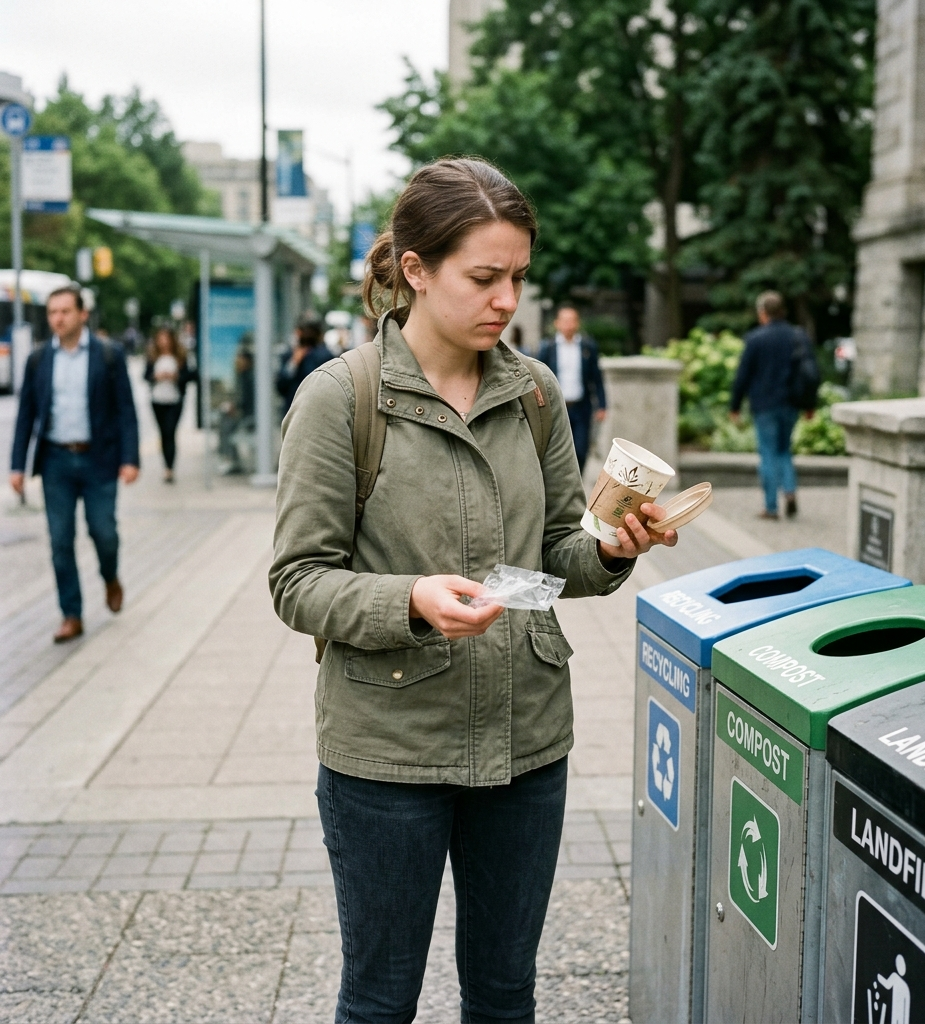
You’re standing at the bin. In your hand, you’re holding a paper coffee cup with a leaf design on it that says “biodegradable.” Next to the bin there is a blue recycling logo. Next to that is a green compost symbol.
A Reuters survey found that 42% of people in that exact moment make a wild guess and throw it in somewhere, anywhere. The rest mostly get it wrong too.
This is not a story about people being careless. It’s a story about three distinct scientific and industrial processes being packaged into almost identical marketing language, almost on everything from packets to car parts, and left for the consumer to decode at the bin.
The result?
Compostable packaging ends up in recycling streams and contaminates entire batches. “Biodegradable” plastics spend 400 years in landfills breaking down into microplastics. And genuinely recyclable materials get tossed because no one was sure.
Three Terms, Three Entirely Different Systems
Recyclable: Materials are collected, reprocessed into raw form, and used to make new products. It requires sorting infrastructure, clean streams, and buyer demand for secondary material.
Biodegradable: It is broken down by microorganisms eventually. No time limit, no conditions defined. Some take weeks in soil others take centuries in landfill. The term alone means almost nothing without context.
Compostable: A subset of biodegradable but with defined conditions, timelines, and outcomes. Must break down in 90-180 days into non-toxic biomass. Certified under ASTM D6400 or EN 13432.
The critical thing to understand is the hierarchy. All compostable materials are biodegradable but all biodegradable materials are not compostable. A plastic bag labelled “biodegradable” may spend 200 years in a landfill, slowly fragmenting into microplastics that enter the food chain. It technically biodegraded. It did not, by any stretch, do something good for the environment.
“The main issue is that biodegradable products aren’t necessarily good for the environment. Some plastics labelled biodegradable break down into tiny microplastics and those are potentially more harmful than the original plastic.”
~ Impact Solutions, 2025 / GreenPrint Products, 2026
Compostable items have standards related to their claim, those certified compostable materials should meet ASTM D6400 (United States) or EN 13432 (Europe) in order to break down in accordance to composting conditions within a set amount of time and leave behind no toxic material during the course of their breakdown (i.e., after being composted).
However, composting conditions typically refer to industrial facilities that have controlled levels of heat, moisture, humidity, or bacteria or microorganisms. As such, if you were to place an actual compostable certified cup in your garden, it could take several years for that item to break down because the conditions needed for it to do so would not be present in your garden. Additionally, if you were to place a compostable certified cup in the wrong bin, you would be contaminating the recycling process.
The Contamination Problem
Plastics that are compostable and biodegradable are not recyclable. When compostable or biodegradable plastics are thrown into recycling streams (which is frequently the case because consumers are confused about the two different type of plastic products), they cause entire batches of other types of recoverable materials to become contaminated and thus unable to be recycled.
For example, one compostable cup could contaminate hundreds of kilograms of PET bottles and make it impossible to recycle that material. Packaging Gateway (2025) found that recyclable materials have a greater percentage of “correctly disposed” than compostable materials because they have clearer symbols and regulations associated with their disposal. Additionally, the lack of large-scale composting facilities for compostable products in many cities is another reason why recyclable materials have a greater percentage of correct ‘disposal.’
Which One Should You Choose?
It depends on the actual end-of-life infrastructure that is available in the areas where your product will be used. In places with large industrial composting collection systems like many cities in Germany, the Netherlands, and Italy, for instance, where compostable packaging has reached a 57 percent recycling rate in 2023 (already exceeding the projected European Union target for 2030) compostable packaging will provide companies with a very strong option to dispose of food-contaminated materials that will not be able to be recycled. Whereas in most of the world, which lacks any industrial composting systems and relies predominantly on the curbside collection of recyclable materials as the primary method of disposal and recycling, people will be more likely to use recyclable materials such as PET, HDPE and aluminum, which are in demand as secondary material. It is not because composting is somehow less desirable than traditional recycling rather, it is preferable to use materials from a recycling system that works imperfectly, instead of using materials in a theoretically ideal system that does not actually exist in the community where you will be using your product.
The standalone term “biodegradable” seems to be more of a warning than a benefit due to its lack of a clearly defined standard. In 2025-26, the EU’s Green Claims Directive is going to pass into legislation that will require scientific support before you can use these terms. Additionally, vague biodegradable claims have already been flagged by the US FTC’s Green Guides as likely to mislead consumers. The days of using verification-free leaf logos are coming to a slow and certain end.
Frequently asked questions
Q: Can I put compostable packaging in my home compost bin?
Sometimes but not as much as you might think from looking at the label. The ASTM D6400/EN 13432 certified compostable packaging is designed to break down in industrial compost facilities, which operate at very high temperatures (about 55-60°C) with controlled moisture and microbes present. Your home composter is unlikely to achieve these temperatures. Packaging with an OK Compost Home or Seedling Home logo has been tested for breakdown in home composting conditions. It is these types of products that will actually decompose in your backyard composter. Ordinary industrial compostable packaging may take 1-3 years or fail to break down completely when placed in your backyard compost bin.
Q: Is “biodegradable plastic” actually better for the environment?
No, not always, and in many cases it may even be counterproductive. This is because there is no set time frame or conditions for “biodegradability” on its own. The process can occur in a very limited number of ways, and in particular, biodegradable plastic requires certain conditions of heat or UV exposure or specialized industrial composting processes in order to decompose. As most of the plastics end up in landfills, in these conditions, the behavior of biodegradable plastic does not differ much from conventional plastic products. It degrades somewhat faster but produces more numerous microparticles. Studies indicate that degradation into microparticles can cause more harm than conventional products, since they are easier to ingest.
Q: Why does compostable packaging contaminate recycling streams?
It’s because compostable bioplastics (such as PLA or polylactic acid) are virtually indistinguishable from traditional petroleum-based plastics (such as PET). They both share similar appearances and tactile qualities but vary significantly in their melting points and chemical makeup. Should a PLA cup be mistakenly placed inside a PET recycling bale, it cannot be removed via mechanical means and will compromise the integrity of the whole load; the contaminated batch will yield subpar recycled plastic that isn’t fit for commercial purposes. Specialized sorting plants are now using near-infrared spectroscopy to detect bioplastics, though such capabilities remain rare within municipal recycling programs. So, never recycle compostable materials, even if you don’t know what else to do with them.