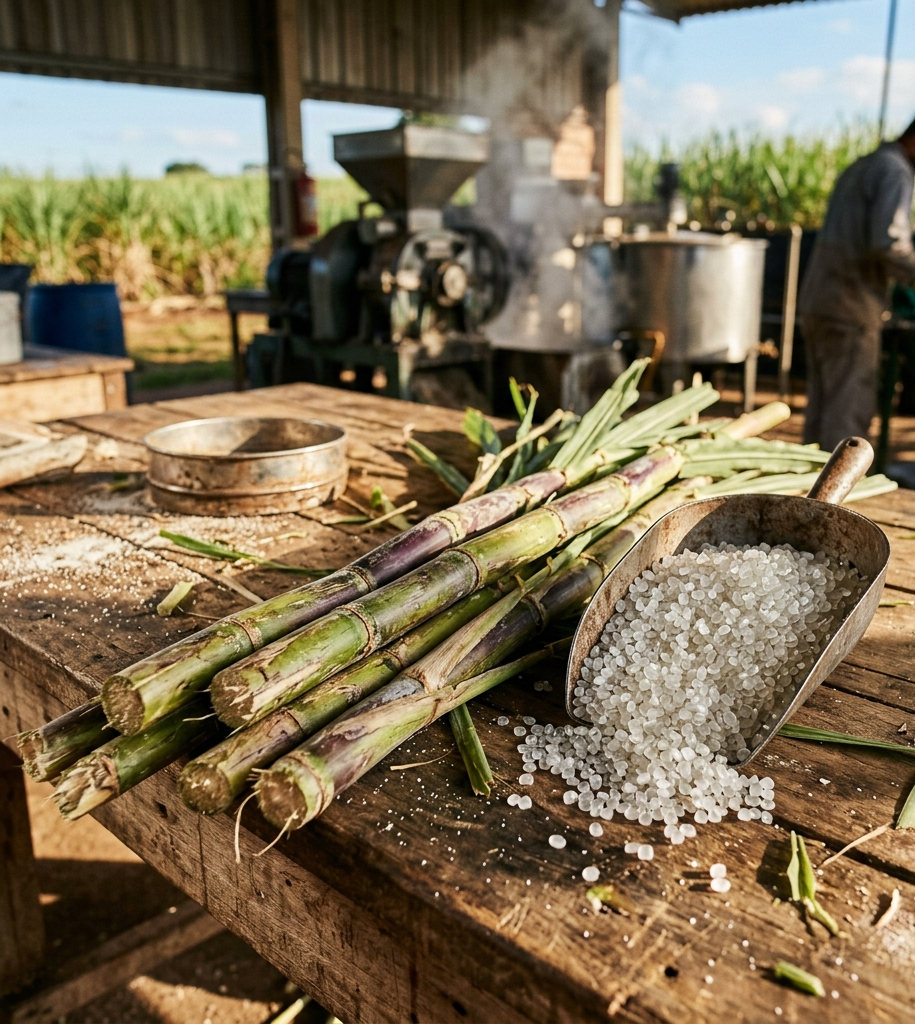
Surprisingly, sugarcane we consume for various purposes is the very same cane that could be used to manufacture one of the greatest advancements in the production of material in the history of industrial development.
Yes, that cane will become a plastic.
Sounds cool? Right?
Why sugarcane?
Besides all other bioplastic feedstock plants like corn starch, cassava, cellulose and algae; sugarcane has a strong advantage as one of the most effectively grown plants in the world. For starters, it has an extremely high concentration of sucrose and has a long-established harvesting system (especially in Brazil and India) that is well-understood. The crop absorbs carbon while growing, that biogenic carbon then travels through the value chain and ends up chemically locked in the final plastic product.
According to a peer-reviewed lifecycle assessment conducted by TotalEnergies Corbion, biobased PLA (polylactic acid) made from sugarcane has a carbon intensity approximately 75% lower compared to traditional fossil fuel-based plastics when considering the storage capacity of biogenic carbon. This is a significant difference and represents a true transformation in carbon intensity levels.
The PLA Manufacturing Journey
- Harvest: sugarcane is cut & crushed to extract sucrose-rich juice.
- Fermentation: bacteria convert sugars into lactic acid over several days.
- Purification: lactic acid is filtered, concentrated & refined.
- Polymerization: lactic acid chains bond into long PLA polymer strands.
- Extrusion: melted PLA is shaped into pellets, films, or formed products.
- Shelf: finished packaging reaches brands, retailers & consumers.
Global Bioplastics Production Capacity
The gap between 0.6% and the rest of the plastic world sounds discouraging until you look at the trajectory. European Bioplastics e.V. projects global bio-based plastic production capacity will double from 2.31 million tonnes in 2025 to 4.69 million tonnes by 2030. Japan’s 2025 Plastic Resource Circulation Strategy targets a 25% market share for sustainable plastics by 2030. And China’s nationwide single-use plastic ban, combined with aggressive PLA and PBAT manufacturing scale-up, is pulling the global supply curve sharply upward.
Not All Bioplastics Are Created Equal
Biobased doesn’t mean biodegradable, which is one of the key things you should know about bio-based products that were not put on their labels. Bio-PE (bio-based polyethylene) is produced using sugarcane ethanol, but doesn’t behave any differently from traditional fossil fuel-based polyethylene (fossil PE) while in contact with the environment, biobased polyethylene will not decompose as fast as fossil polyethylene under any circumstance. Conversely, some fossil-based plastics (PBAT) are biodegradable when put through an industrial composting process.
The plastics that most consumers would likely think of when they hear “plant-based plastic” are actually two types of materials that are both biobased as well as biodegradable: PLA and PHA.
PLA and PHA will both break down within 20-180 days, though PLA is usually the quickest to break down because it gets put through industrial composting. PHA can be biodegraded with the help of living organisms like bacteria in both soil environments as well as marine ecosystems. A 2025 ScienceDirect study showed that a PLA material manufactured using new technology has improved heat resistance, making it suitable for use in automotive applications which indicates that these materials are being used for more than just one-time use cups.
The industry is working on all of it.
The current cost of producing PLA is about 20-30% more than producing petroleum polyethylene. Some PLA products require industrial composting facilities to degrade, many of these facilities do not exist where the product will be discarded. Growing sugarcane at scale has land-use implications. Many bioplastics will only degrade in specific conditions and therefore may act like regular plastic if simply thrown away in a landfill.
The industry is addressing these issues. In September 2014, the CSIRO and Murdoch University in Australia launched the Bioplastics Innovation Hub with an $8 million investment to research development of bioplastics that are able to break down in soil and water, not just able to decompose in a commercial facility. In 2010, Braskem started making bio-polyethylene from sugarcane. The EU’s Packaging Regulation will clarify and tighten definitions of products made from renewable resources by 2025. The gap between what is marketed and what is real is closing.
Frequently asked questions
Q: Is plant-based plastic actually better for the environment?
Mostly, yes. Sugarcane-derived PLA has a carbon footprint 75% smaller than that of fossil fuel plastics according to peer-reviewed life cycle studies, mainly due to its ability to absorb carbon dioxide from the atmosphere during growth (biogenic carbon). But biodegradability differs vastly depending on the type of bioplastic, some require specialized composting, while others degrade in soil and water. The environmental impact of land use for raw material cultivation cannot be overlooked either.
Q: How is sugarcane turned into PLA plastic in simple terms?
Initially, the sugarcane is crushed, and the liquid squeezed out from the sugar cane. Then the liquid is subjected to fermentation by bacteria resulting in production of lactic acid which occurs in sour milk. Then lactic acid undergoes purification after which, through polymerization of molecule chain formation using ring-opening polymerization, there is production of polylactic acid (PLA). PLA is then melted and molded into pellets used for production of PLA packaging.
Q: Can plant-based plastics replace all conventional plastic uses?
Not yet and possibly not entirely, by design. Bioplastic alternatives now exist for almost every conventional plastic type (European Bioplastics e.V., 2025), but performance gaps remain in high-temperature, high-stress, and long-life applications. A 2025 ScienceDirect study reported a new PLA variant with enhanced thermal stability suitable for automotive interiors, a gap that was uncrossable just a few years ago. The realistic near-term picture is a mixed material world: bioplastics dominating single-use and packaging applications while fossil-derived plastics persist in long-life industrial uses. The goal isn’t purity, it’s reducing the total environmental footprint.