Did you know that deep inside a mushroom’s root system lies the answer to one of packaging’s biggest problems?
It’s the mycelium.
What exactly is mycelium?
Fungi have a complex underground network called mycelium which connects and binds everything together in the ground through tiny threads that branch out and grow into soil and even remnants of crops. This has been happening for 1.3 billion years before scientists discovered how to use it in production facilities for everything from mushroom production to textiles.
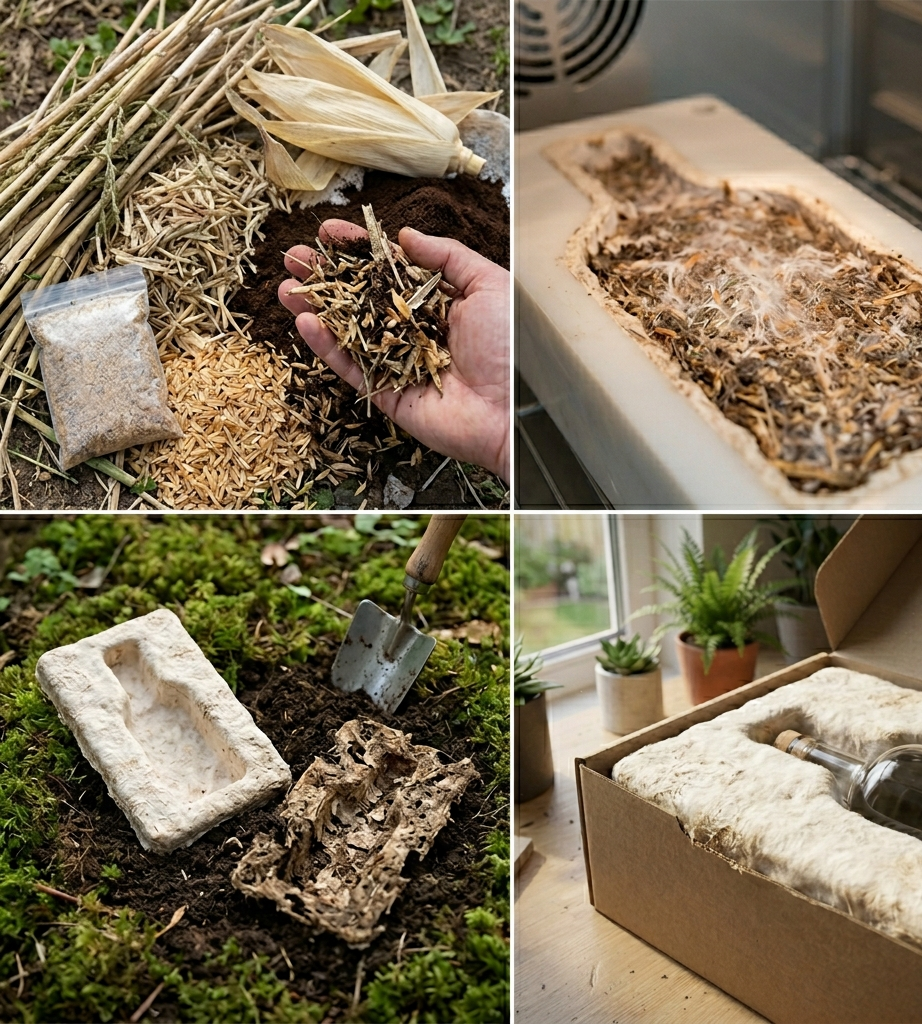
Agricultural by-products like hemp stalks, corn husks, rice hulls, even spent coffee grounds are packed into a mold. After that fungal mycelium is introduced. Over 4–7 days, it grows into every crevice, fusing the organic matter into a dense, custom-shaped composite. The mold is then heat-treated to halt growth and lock the shape. What you have is a material that matches polystyrene’s protective qualities but completely decomposes in a home garden within weeks.
For years, mycelium packaging was a great idea stuck in a university lab. That era is over. The global mycelium packaging market hit $84.9 million in 2024, while it is estimated to grow to $228 million within 11 years. Moreover, there is also greater growth projected for mycelium packaging in general. According to a recent report from Marketintelo, larger-scale production of mycelium packaging will reach $7.2 billion in revenue by 2034 and be at an even faster rate.
What caused the change?
Two factors contributed to this: Accountability and Regulation.
IKEA announced in late 2024 a switch to mycelium-based packaging developed by Ecovative, the New York-based pioneer that’s been at this since 2007. Dell has been shipping servers cushioned in mushroom packaging for years. Patagonia followed. What was once a brand differentiator is fast becoming table stakes.
Meanwhile, governments have been systematically banning single-use plastics and EPS foam. The European Union’s plastics directive, carbon tax structures, and national-level packaging mandates have pushed businesses to find alternatives not someday, but now.
A 2026 Paper
A February 2026 study published in Polymers (Thomas Jefferson University) tested mycelium composites made with industrial hemp biomass directly against polystyrene packaging for mechanical performance.
The result:
Mycelium-hemp composites achieved comparable structural integrity, while using a feedstock that is itself a waste product. In the US alone, over 45,000 acres of hemp were planted in 2024, a 64% jump from the year before and roughly 90% of that biomass becomes residual waste. Mycelium turns that waste into packaging.
What Is Still Required?
Currently, mycelium packaging is sold at a 20-35% premium over EPS foam (equivalent) packaging, though production scale has improved and a cost parity hasn’t yet been achieved. Certain applications (especially those which need insulation to remain waterproof or resistant to extreme temperature) continue to need some innovative engineering breakthroughs. Also, there continues to be very low consumer awareness (particularly in developing countries) of this packaging technology.
Ecovative has partnered with Rensselaer Polytechnic Institute to develop fire-retardant and water-repellent formulations. Grown Bio has done the same with Wageningen University. Manufacturing maturity will help the companies reduce production costs by approximately 30-40% between 2025-2030. Thus, the potential 20% premium for this packaging technology that seems so shocking today is no different than the premium that solar panels had in 2010.
Frequently asked questions
- Q) Is mycelium packaging actually strong enough to protect fragile products?
Absolutely yes! In fact, the fact that it does is not just theoretical but also proven by practice. For example, Dell has been using mycelium-containing packaging for its servers since the beginning of time. In a 2026 experiment carried out at Thomas Jefferson University, the material proved its superiority to polystyrene in a comparison of their mechanical properties. Mycelium is very customizable in terms of shapes and sizes.
- Q) How long does mycelium packaging actually take to decompose?
Under household composting circumstances, mycelium packaging is completely decomposed within 30 to 90 days without any trace of microplastics or toxicity. However, under industrial composting conditions, it decomposes within 15 to 45 days. Mycelium packaging meets the standards for compostability set by ASTM D6400 (US) and EN 13432 (Europe). Conventional Styrofoam will take centuries to millennia to degrade into microplastics.
- Q) What kind of agricultural waste can mycelium grow on?
The best part about mycelium is that it is highly tolerant. Mycelium has been cultured on hemp shive, corn stalks, rice husk, wood flour, cardboard, coconut pith, and even coffee grounds with success. This tolerance is beneficial in two ways, first in terms of localization; this means that whatever agricultural waste is available in the region can be converted into raw material without having to travel far distances. As shown in an Indian study conducted in 2024 at Nuvedo labs, Pleurotus ostreatus was cultured successfully on cardboard and paper.