Picture your morning coffee. You grab it in a cup stamped with a green leaf and the word “compostable” written on it. You feel good about it. You toss it in what looks like the right bin. And then, almost certainly, nothing happens.
The cup sits. It waits.
It sits where people put it, and will be put in a landfill because it will not be processed properly; this cup is no different from a plastic cup.
This is not the fault of the individual, rather, it is due to a labelling issue, lack of knowledge about how the product is made, and increasingly, a lack of regulation. To fully understand what is wrong with this system, let’s take a closer look at these components, one at a time.
The Word “Compostable”
Approximately 500 billion coffee cups for take-out are consumed each year worldwide, and most of them become waste causing environmental degradation in oceans, thus affecting biodiversity, tourism, fishing, and shipping industries. It seemed that an answer to all the problems would be found in the form of compostable options. However, the solution came quicker than the necessary resources.
What is not so widely acknowledged is that not every ‘compostable’ coffee cup has the same level of acceptability as described above when considering the end of it’s lifecycle.
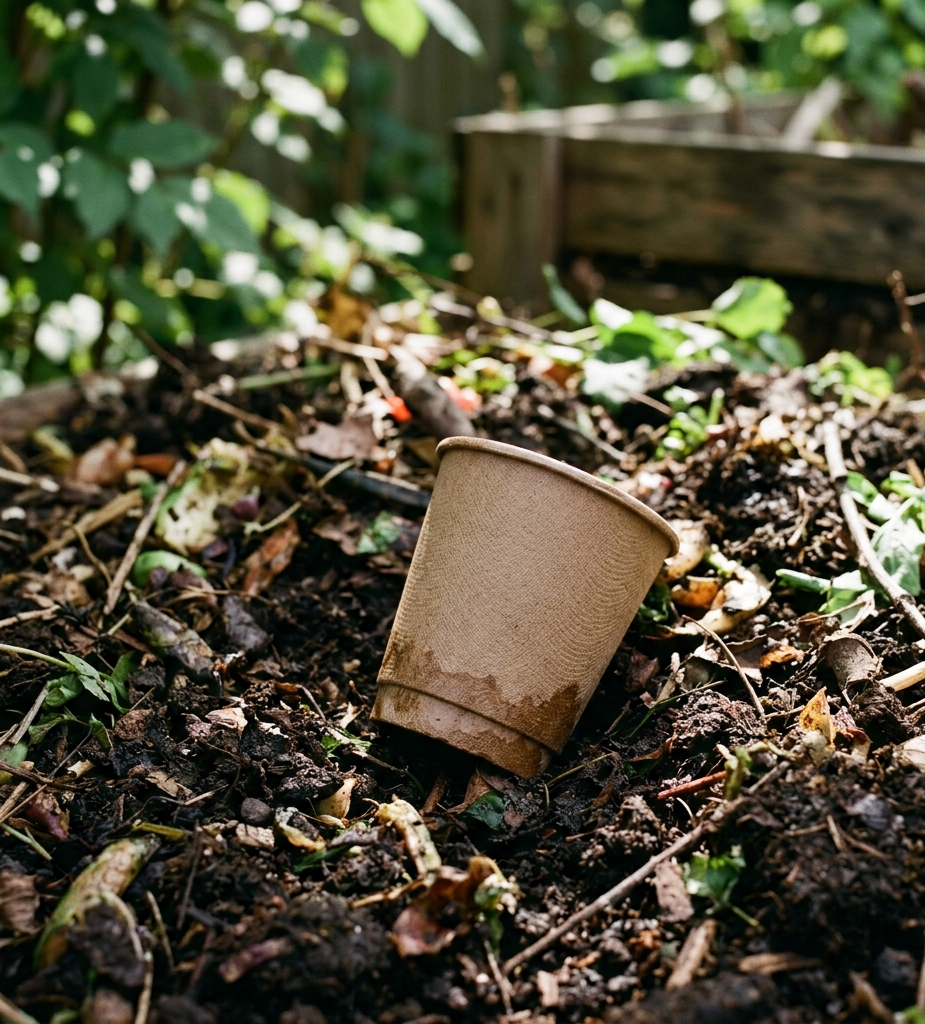
PLA is polylactide, originally classified as bio-based which is the most common material used to make ‘compostable’ coffee cups and can only be broken down in industrial composting facilities operating at greater than 60 degrees Celsius. Otherwise PLA will persist in your household compost, in landfills, or in the ocean for decades.
A 428-day marine study concluded there was not one instance of PLA degrading in the marine environment.
That green leaf on your cup? It often means compostable, but only if you happen to live near one of the industrial facilities that accepts it and most people don’t.
What Actually Makes a Cup Truly Compostable?
A genuinely compostable cup has to clear three distinct bars:
- The material bar:
PLA cups break down through two processes:
- Hydrolysis, the chemical bonds in the PLA are cleaved by heat/moisture (environmental factor).
- Microbial Mineralization, the microbial entities present in the comps allow the hydrolyzed fragments to be converted to CO2, H2O, and biomass.
However, both processes require aerobic conditions (high heat: ~58 degrees celcius, moisture, and O2), and if any one of them is inaccurate (wrong), then instead of completely decomposing (breaking down), the cup only fragments into pieces.
- The certification bar:
Truly compostable cups must meet EN13432 or ASTM D6400 standards and fully decompose within 90–180 days under industrial composting. BPI Certification (one of the most trusted North American certifications for compostability) requires verification that a product is biodegradable, disintegratable, non-ecotoxic and tested for total fluorine and all chemical composition.
Also, in September 2025, BPI will have a new certification category for compostable products that are designed to decompose in backyard composting systems, thus closing the gap between the product label and actual decomposability timeframes.
- The system bar:
This one is the most difficult. Even BPI-certified cups face a system problem: many industrial composters operate on cycles too fast for PLA to fully break down, and they’re not incentivized to adapt. Compost made with PLA containers in the US also cannot be certified organic.
Compostable Cup Materials
Material | Home compost | Industrial compost | Hot drinks | Marine safe | PFAS free |
PLA | ✗ | ✓ | ~ | ✗ | ✓ |
PLA / PHB blend | ✓ | ✓ | ✓ | ✓ | ✓ |
Bagasse | ✓ | ✓ | ✓ | ~ | ~ |
Lined paper | ✗ | ~ | ✓ | ✗ | ✗ |
Legend: ✓ = Yes ✗ = No ~ = Conditional / depends on product | Sources: PMC/NCBI, PlantSwitch, BPI, ASTM D6400
The current leaders in cup development are PLA/PHB blends, which have been demonstrated to have similar or better rates of degradation than a pure cellulose material under the same conditions in some composting facilities (municipal solid waste). In addition, neither of these types of plastics leaves behind microplastics when composted in a municipal or home composting environment.
Critically, the same study found that PLA will have 92.3% mineralization at 58°C (the temperature in a commercial composting operation) and 14.9% mineralization at 25°C (typical home composting temperature), which explains why PLA cups do not ultimately compost in home composting operations.
Bagasse is the fiber that is left behind after sugarcane has been crushed. In the current times, 35% of the entire export of compostable cups is made up of certified bagasse, which can be utilized for producing compostable cups that are heat-resistant and industrial-compostable.
The Regulatory Scenario
The EU Single-Use Plastics Directive bans “biodegradable” plastic claims without certification. Canada’s 2024 plastics ban mandates third-party compostable certification for alternatives. BPI reports a 28% year-over-year increase in new certifications from 2023 to 2025. The era of vague green claims on cups is quietly closing.
The EU’s Packaging and Packaging Waste Regulation (PPWR/2025/40), adopted in early 2025, intensifies regulatory pressure on manufacturers to demonstrate actual recyclability and real carbon footprints, not just marketing claims.
What Should You Actually Look For?
If you want to know if a cup you are using is compostable in 2025, there will be 3 things on its label. One will be the type of material used, another will be what agency certified it as compostable (like BPI or TÜV) and finally where it can be composted (i.e., industrial vs. home). If a cup is labeled as “compostable” but cannot clarify if it’s for industrial or home composting, I would consider that claim suspect. There isn’t anyone better than TUV as they certify all types of compost (industrial, home, marine) and as such are the only real valid choice for a full all-encompassing warranty.
Frequently Asked Questions
- Q) Can I put a compostable cup in my home compost bin?
Not typically, unless your cup comes with a special “home compostable” label such as OK Compost HOME or the recently introduced BPI home compostable certification program introduced in September 2025. Normal PLA cups need industrial-grade temperatures up to 58°C, which is much hotter than any backyard compost heap can generate, and they would last for many years in a home composting or landfill environment.
- Q) What’s the difference between “biodegradable” and “compostable” on a cup?
“Biodegradable” is an overarching, unregulated term even if the cup will take many years to biodegrade it can be sold as such according to regulations. “Compostable,” on the other hand, is a much stricter term referring to the cup being able to meet a certain standard (such as ASTM D6400 or EN13432) within a set time frame.
The European Union has prohibited the use of “biodegradable” without certification.
- Q) Are PLA/PHB blend cups significantly better than standard PLA?
Yes, meaningfully so. Published research shows PLA/PHB blends degrade in both industrial and home composting environments without leaving microplastics, something standard PLA cannot claim. The PHB component provides microbial “hooks” that accelerate breakdown even at lower temperatures.