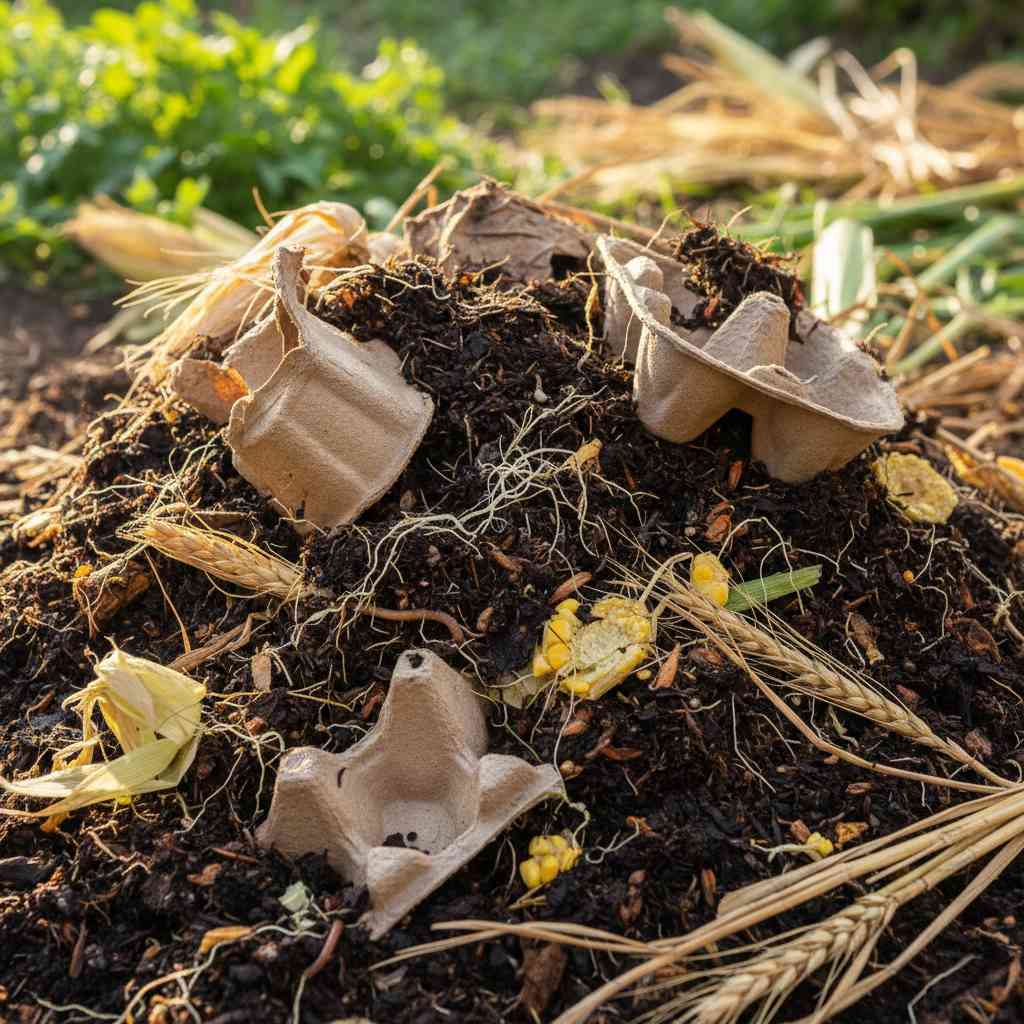

Are you aware of the material that farmers are currently burning that may actually hold the key to saving our planet?
It’s not fossil fuels or plastic waste (although they should also be dealt with), but rather crop residues such as stalks, straw, and husks from harvested crops. These crop residues are currently being burned in agricultural fields, emitting a total of 2.4 petagrams of carbon dioxide annually worldwide according to a study published in GCB Bioenergy.
Therefore, if farmers create biochar by burning crop residue biomass, which is a form of carbon lock-up, then the consequence would be a climate solution which locks up 0.72 petagrams of carbon dioxide by the end of each year. This is equivalent to 45% of total greenhouse gas emissions produced in the agricultural sector.
Sounds like we’re literally burning the solution, right?
Well, this is biochar science, and the numbers prove it’s one of our most scalable climate fixes.
The Carbon Sequestration Powerhouse:
The advantages of crop residue biochar are amazing. Nature Communications’ research shows that biochar has the ability to sequester 0.92 billion tons of CO2 each year from the atmosphere at an average price of $90 per ton. The data also shows that approximately 1 ton of CO2-equivalent produced from 1 ton of crop residue as biochar helps to reduce atmospheric CO2 by 0.92 Mg. Additionally, the conversion of 585 metric tons of crop residue into biochar sequesters 264 metric tons of atmospheric CO2 annually.
Research performed in npj Materials Sustainability indicates that globally, biochar can sequester between 0.7 and 1.8 Gigatons of CO2-equivalent per year. This is a very durable form of carbon storage, with The Nature Conservancy research revealing that approximately 60-100% of carbon in biochar remains sequestered after 100 years depending on the climate, and based on research north of the environment, the duration of storage of stable carbon in biochar ranges from a minimum of 90 years to a maximum of 1,616 years.
Long-term carbon sequestration research in PNAS shows that carbon sequestered in biochar enhances crop yields, improves soil carbon storage, and decreases greenhouse gas emissions. The GCB Bioenergy report finds that the countries pictured above have the greatest quantity of carbon sequestration potential from biochar. China has 128 teragrams carbon per year, the USA has 104 teragrams carbon, India has 82 teragrams carbon, and Brazil has 47 teragrams carbon.
The Multi-Benefit Climate Strategy:
Now here is what makes this truly elegant: this carbon sequestration material is not only sequestering carbon but it is also providing agricultural benefits. According to ScienceDirect, the results of the study demonstrate that through the various applications of the biochar created from the corn residue, the emission of 2.56 billion tons of CO2 equivalent is mitigated. The application of biochar results in the sequestration of 5 percent of the total greenhouse emissions. Studies prove that the increase of 30 tons per hectare of corn residue biochar increases the efficiency of carbon sequestration by 16 percent with a reduction of methane emissions of 132
Consistent with Springer, analysis indicates that twelve countries have the technical potential to sequester more than one-fifth of their current emissions as biochar from crop residue. Bhutan stands at 68 percent, while India stands at 53 percent. Research affirms biochar aids in enhancing soil fertility, water retention capacity, nutrient supply, and metal adsorption, in addition to improving crop productivity.
Why This Matters?
We’re burning what needs to be our carbon drawdown infrastructure, essentially. Multi-institution research has confirmed that avoiding cumulative emissions in the range of 66 to 130 billion metric tons of CO2-equivalent over a century is achievable through pyrolysis and biochar production from crop residues. About 50 percent comes from long-term carbon sequestration and 30 percent comes from substituting fossil fuel use with pyrolysis-derived energy.
We treat crop residues as waste to burn or discard but converting them to biochar sequesters gigatons of CO2 will improv soil health for centuries.