
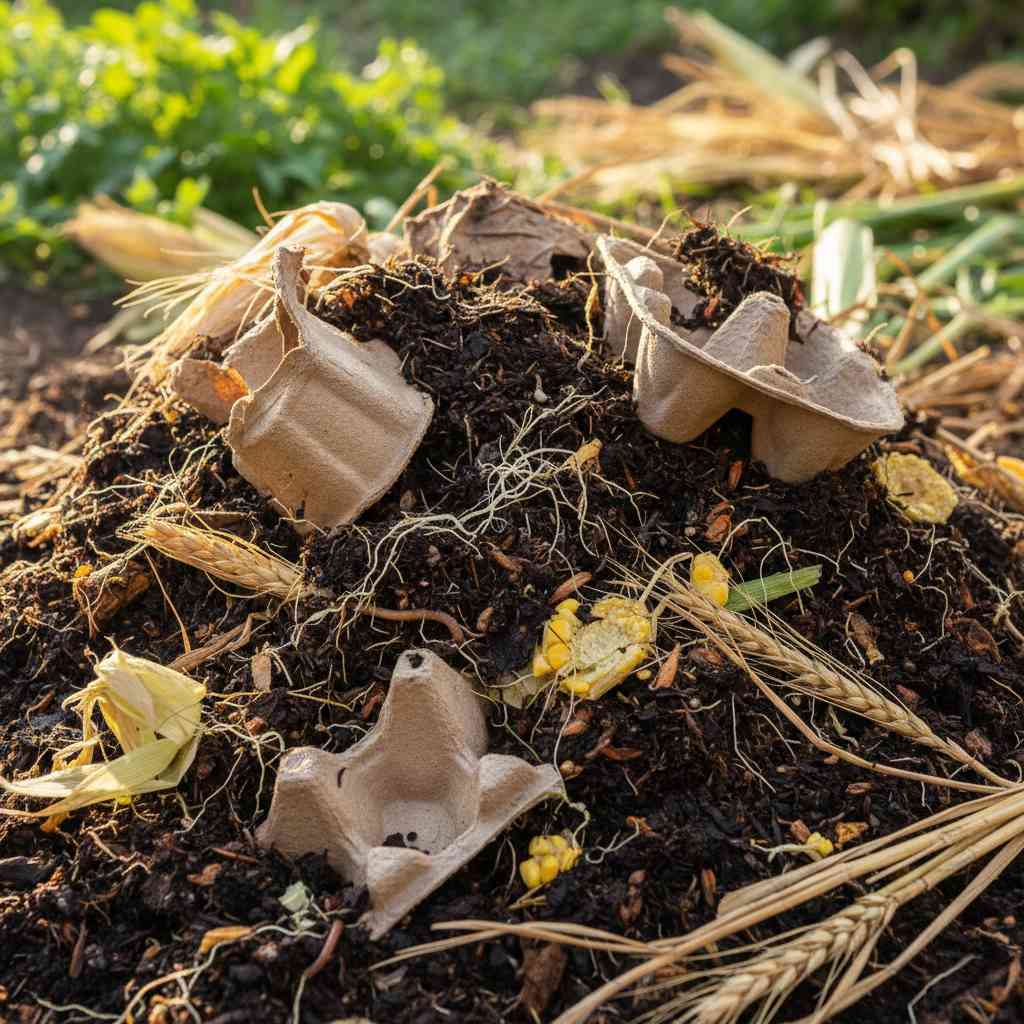
If you strip away the marketing buzz, genuinely compostable packaging doesn’t start in a polymer lab. It starts in plants.
Not PLA. Not exotic bioplastics.
“Cellulose.”
It is the world’s most prevalent organic polymer, providing the backbone for crop residues, husks, and fibers.
Studies indicate that materials based on cellulose can achieve a biodegradation time of around 20 days in industrial composting conditions, which is much faster than many PLA-based materials. At the same time, studies published on PubMed Central indicate that the global demand for packaging is over 144 million tons per year, of which more than 90% is still made from traditional plastics, accounting for over 100 million tons of waste.
The key is this:
Crop residues high in cellulose are not waste materials but already have the potential to be used as raw materials for materials that degrade as claimed.
No greenwashing.
No microplastics left behind.
Just plant carbon going back into the soil.
Why Cellulose Actually Biodegrades?
It is literally what nature designed to decompose.
Research published in the journal PMC upon analysis of biodegradable packaging confirms that materials from starch or cellulose are decomposed by way of cranberry, methane, water, inorganic compounds or biomass via enzymatic activity of microorganisms under composting conditions. With industrial composting at 58°C, 90% mass loss can be achieved within a 60-day time frame for this type of material.
There have been studies published on ScienceDirect in which cellulose produced from trays made entirely from cellulose, achieved 70% pleasure of biodegradation after 60 days even without using liners, and in addition to that, a study published in Scientific Reports show that films created from carboxymethyl cellulose derived from sugarcane bagasse retain excellent properties in regards to barriers against both oxygen and lipids due to cellulose decomposition throughout industrial composting facilities as well as increasingly at home, where most other alternatives require thermophilic temperatures that are rarely obtained in home composting systems.
In addition to this, research published in ScienceDirect indicates that pure cellulose materials that were developed through bacterial cellulose and ethyl cellulose versus a laboratory environment, displayed tremendous strength of 195.3 MPa tensile strength compared to 136.9 MPa of mechanical strength after being submerged for 30 minutes in water as a liquid, while also presenting themselves as inherently recyclable, degradable, and ecologically cost-effective.
The Agricultural Waste Advantage:
One of the key aspects of cellulose as a sustainable material is its abundant availability as an agricultural residue (which has a high cellulose content) with a variety of feeding options such as wheat straw, corn stover, bagasse, and rice husks. These residues can produce materials strong enough for packaging while also having good levels of thermal stability. In addition, recent studies demonstrate that by adding only 4-5 wt % cellulose nanocrystals to chitosan or starch film compositions (compared to those made without them), increases in tensile strength of 26-39% were observed as well as greater thermal stability.
Meyer (2012) states that cellulose nanocrystals derived from plant fibre have excellent strength, light weight, biodegradability, large surface area, and some other unique mechanical properties that make them an excellent candidate for producing strong transparent films, specifically for food packaging since the addition of nanoparticles enhances barrier performance, preventing moisture and gas from escaping through film materials which helps to extend the usable lifespan of food.
The Reality on Compostability:
The reality is that studies on ScienceDirect revealed that despite a similar content of cellulose, the level of degradation varied, with biodegradation rates ranging from 70 percent to only 40 percent after 60 days, while the PLA lining biodegraded only 30 to 0 percent. This is a concern for mixed materials, especially if the non-biodegradable part is not disposed of properly despite the compostable cellulose base.
Studies confirm that only about half of compostable packaging currently reaches appropriate composting facilities according to PMC, meaning material design, labeling, and collection infrastructure must align to ensure packaging actually biodegrades rather than contaminating recycling streams.
Why Cellulose Is the Only Real Backbone?
Because research across multiple institutions proves cellulose delivers genuine biodegradation under realistic conditions while PLA and synthetic alternatives require perfect industrial composting that most packaging never receives. Cellulose doesn’t just claim compostability, it demonstrates it.
Marketing-wise, many materials claim biodegradability but cellulose achieves >90% mass loss within 60 days under real composting conditions.


