“Before you print “compostable” on your packaging, make sure you know what that word actually means and for whom.”
The Story: A Good Decision That Wasn’t
Imagine a fast-casual restaurant chain in Bangalore opting to go green by switching their takeout boxes, lids, and utensils to products labelled with the term “compostable.” They even have a small leaf logo on each item to indicate that they care about sustainability. Customers seem really to appreciate this initiative, as does the local media, who mention the restaurant in a positive light. The owners feel that they have definitely checked off their sustainability box!
Six months later, a staff member discovers a pile of those “compostable” forks stored away in the corner of the break room and they have not changed at all after sitting there for six months. They received an email from an environmentally conscious customer inquiring why these compostable utensils didn’t break down in her backyard composting bin.
What went wrong? The company didn’t do anything illegal or dishonest; it simply appears that they did not fully understand the requirements of composting and did not know there are big differences between composting in an industrial facility and composting in a back yard.
First, What Even Is Composting?
Composting is the recycling of organic matter (environmental) through the natural process of decomposition. By allowing microorganisms (e.g., bacteria) to decompose organic waste (including food scraps, yard waste/paper, and biodegradable packaging) into humus (soil), we can create a rich end product for gardening, landscaping, and farming. This process has been taking place in forests for thousands/millions of years; however, humans have created engineered systems for composting.
There are two main forms/technologies (or methods) of composting used today:
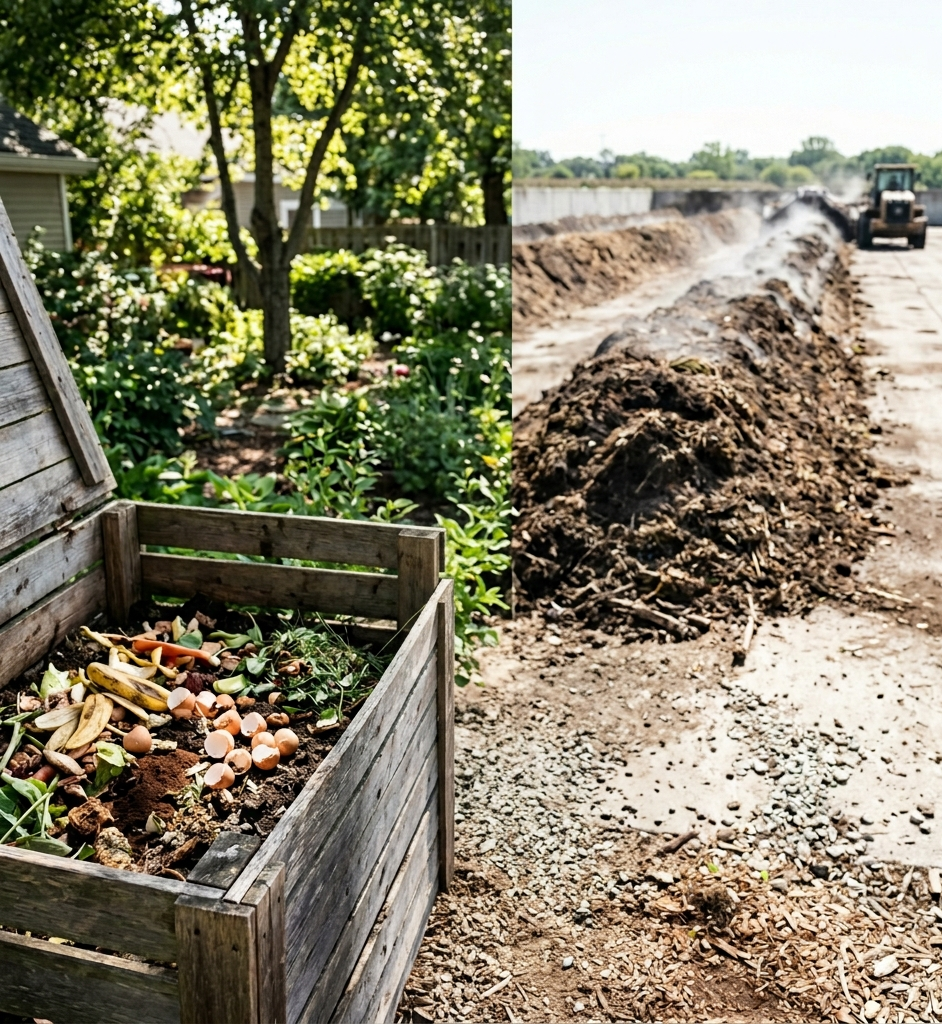
Industrial (commercial) composting and home composting.
Both produce a valuable final product but each uses totally different methods and processes to achieve this goal. As a result, these differences have significant implications for the sustainability decisions made by companies/businesses.
Industrial Composting: Nature at Scale, With Engineering
Industrial composting facilities are essentially advanced biological reactors. Huge amounts of organic waste are collected, separated and worked with through a controlled process that speeds up the decay process at all levels.
55–70°C
Operating temperature, enabling pathogen removal and rapid breakdown
12 wks
Typical breakdown period for certified industrial compostable materials
~30%
Of global food waste currently diverted to composting facilities (est. 2023)
The environment isn’t just created to control the conditions described above; it is also designed to operate as an engine. Research shows us, time and again, that heat, sustained for periods of time in excess of 55°C, creates the right conditions for compost facilities to break down difficult materials such as bioplastics and particular types of cellulose-based plastics within weeks and at the same time kill off harmful pathogenic organisms, which will live in cooler environments. A study conducted in 2021, published in Bioresource Technology, confirmed that to degrade poly-lactic acid (PLA), one of the most common materials used in “compostable” packaging, to commercially viable levels within the time frames of an average composting facility, the temperature of the composted material must reach 55°C.
“Industrial composting doesn’t just accelerate what nature does, it changes the conditions so fundamentally that some materials simply won’t decompose without it.”
These facilities also regulate moisture content, carbon-to-nitrogen ratio, and aeration to create a conducive environment that stimulates the rapid growth of microbial life. This leads to compost that has a higher concentration of nutrients, which can be utilized by both farmers and municipalities as part of their input materials as well as providing them with the means of growing food. From our perspective, this output is a true circular economy, not just waste diversion alone.
Home Composting: Slower, Simpler, Surprisingly Powerful
Home composting is not the same as your neighbour’s backyard bin.
For example, the compost temperature in your home is generally 20-35 degrees Celsius on average, which will break down things like garden clippings, coffee grounds and vegetable skins in a few weeks to months, but that temperature would not be adequate to process biodegradable plastics or more complex organic polymers that modern-day manufacturers produce commercially.
But there are many benefits of composting your household waste that are overlooked in business discussions. The MDPI’s 2022 study on home composting showed that it has considerably less of a carbon footprint from transporting waste than businesses. There is no curbside pickup for your backyard compost bin, no commercial composting facility for processing the material once collected, and no costly supply-chain requirements due to fuel production used to transport compostable material to a composting facility. Composting is simply an efficient, low-emission alternative to landfilling.
Importantly, research continues to show that compost produced from correctly managed home compost can have a nutrient value commensurate with that of commercially produced compost. The ScienceDirect study demonstrates that both home and commercial compost produced under proper management practices contain comparable levels of plant nutrients (nitrogen, phosphorus, and potassium). The significant difference is the consistency of how the compost is produced, as well as the range of input materials that can be processed through each method.
The Real Differences Beyond the Temperature Chart
Parameter | Industrial Composting | Home Composting |
Temperature | 55–70°C sustained heat | 20–35°C ambient heat |
Materials Processed | Processes PLA bioplastics | Food scraps, garden waste only |
Time for Breakdown | Weeks to breakdown | Months to breakdown |
Infrastructure | Requires collection infrastructure | Zero transport required |
Efficiency | High throughput, consistent output | Dependent on management skill |
Cost & Energy | Higher energy, managed systems | Low energy, low cost |
Pathogen Control | Pathogen destruction guaranteed | Not always guaranteed |
The scale difference is staggering. A single industrial facility can process thousands of tonnes of organic material per year. A home compost system handles perhaps a few hundred kilograms. But scale alone doesn’t determine which is “better” — it determines which is appropriate for different waste streams.
What Businesses Actually Need to Get Right?
Referring back to the restaurant chain in Bangalore, their mistake was not to be malicious. Rather, their mistake hinged upon a structural shortcoming. The chain had selected packaging materials certified to the EN 13432 and other standards for industrial composting; however, they took it a step further by communicating to customers that their packaging was produced using home composting materials. The two certifications are not the same, and therefore the two are commonly confused as “green washing” in the sustainable packaging world.
Caution:
Be careful to make sure that any compostable product is marked only with ‘compostable,’ as the product can be marked for industrial composting purposes without regard to whether or not the district in which it is being sold has been set-up for the appropriate composting facilities. Hence, this is a violation of the FTC Green Guides and various other equivalent guidelines stated above, where companies are accused of misrepresenting or overstating the environmental characteristics of a product.
The following is a useful guide for companies that are determining their package options:
Understand your end-of-life options. When you consider using compostable packaging materials, determine first if your target market has easy access to industrial compost facilities. In many of India’s cities (including several major urban centers), the lack of municipal capacity to compost is growing, but supply is patchy. If your customers do not have the ability to use composting facilities, compostable packaging will most likely go to a landfill, where it does not perform any better than regular plastic.
Verify that the package type matches the composting certification. Home-compostable certified packages (like Australian AS5810 and TÜV Austria’s OK compost HOME Recycling certification) is a much higher qualification than an industrially certified product and is far more important for products that end up in residential waste streams. So, if your product is able to decompose in your customer’s backyard, indicate this information specifically and with proof.
Packaging shouldn’t be the only reason for sustainability! Some companies, while using compostable packaging, have actually added overall weight to packaging or created packaging with energy intensive processes to produce it; therefore, an all inclusive waste removal strategy by lowering the packing volume, creating a reusable design and optimising the supply chain will always have a greater impact on the environment than changing only one material for another.
Educate your customer, or do not. If you can’t show them how to properly dispose of your compostable cup (since they must use a commercial facility to dispose of it properly) and you don’t think there are any in their city, then the claim of being green does more harm than good. Trust is lost faster when vague green claims are made than when nothing is said at all.
Looking Forward
The changes occurring in composting are abrupt. The Solid Waste Management Rules issued by India have applied considerable pressure against companies to properly handle biodegradable waste, and many cities now require businesses to separate wet waste at the source. Although a divide still exists between what companies dream about doing and how households actually do it, it is closing slowly.
Consumer understanding of composting has increased dramatically, and consumers want to see detailed information about where and how to compost. This is a positive change because it will require companies to be specific in describing how to compost instead of just providing broad statements about being environmentally responsible.
The restaurant chain finally reached maturity a few steps down the road. They replaced the PLA cutlery with alternatives in bamboo (which is truly compostable at home or in a commercial composter), worked with a local industrial composter together with the composting of all their kitchen waste, then updated their in-store messaging from symbolic to concrete terms providing proof of their environmentally friendly practices. This was not a “revolution of the marketplace”, this was simply about being honest which in this area of business (sustainability) tends to end in the longest lasting pattern of results.
Frequently asked questions
- Q) Is industrial composting better than home composting?
Neither is superior. Industrial composting deals with a broader spectrum of materials in a quicker way while home composting creates less harm in handling household waste. The key is which process would be available for particular garbage.
- Q) Can “compostable” packaging break down at home?
In most cases, it can’t because it requires an additional certification mark indicating that the product can be safely disposed of in home conditions. In any other case, it won’t decompose even if you have an operating compost heap in your backyard.
- Q) Which option is more sustainable for businesses?
Well, it all depends on the type of waste generated by the business and the access that their consumers have to facilities. For businesses involved in the food service industry, where industrial composting facilities are available, it makes sense for them to utilize certified industrial compostable packaging. However, when the products reach consumers who lack easy access to such facilities, it becomes an honest choice to utilize home-compostable products or reusable ones.
- Q) How should companies choose between the two?
End-of-life considerations should always be part of any decision. Businesses must first consider what happens to the product once it comes to an end-of-life stage. When industrial composting is possible and facilities are available for this purpose, industrial composting is feasible. When facilities aren’t available, using a home-compostable certification may be a more sensible approach.
- Q) Are compostable plastics truly eco-friendly?
Not necessarily. Compostable plastics such as PLA produce fewer greenhouse gases throughout their life cycle compared to petroleum-derived plastics, but only under the right conditions. Yet if these products find themselves in the wrong environment, such as being disposed of in landfills, the ocean, or regular recycling facilities, which often happens, they become just as problematic.