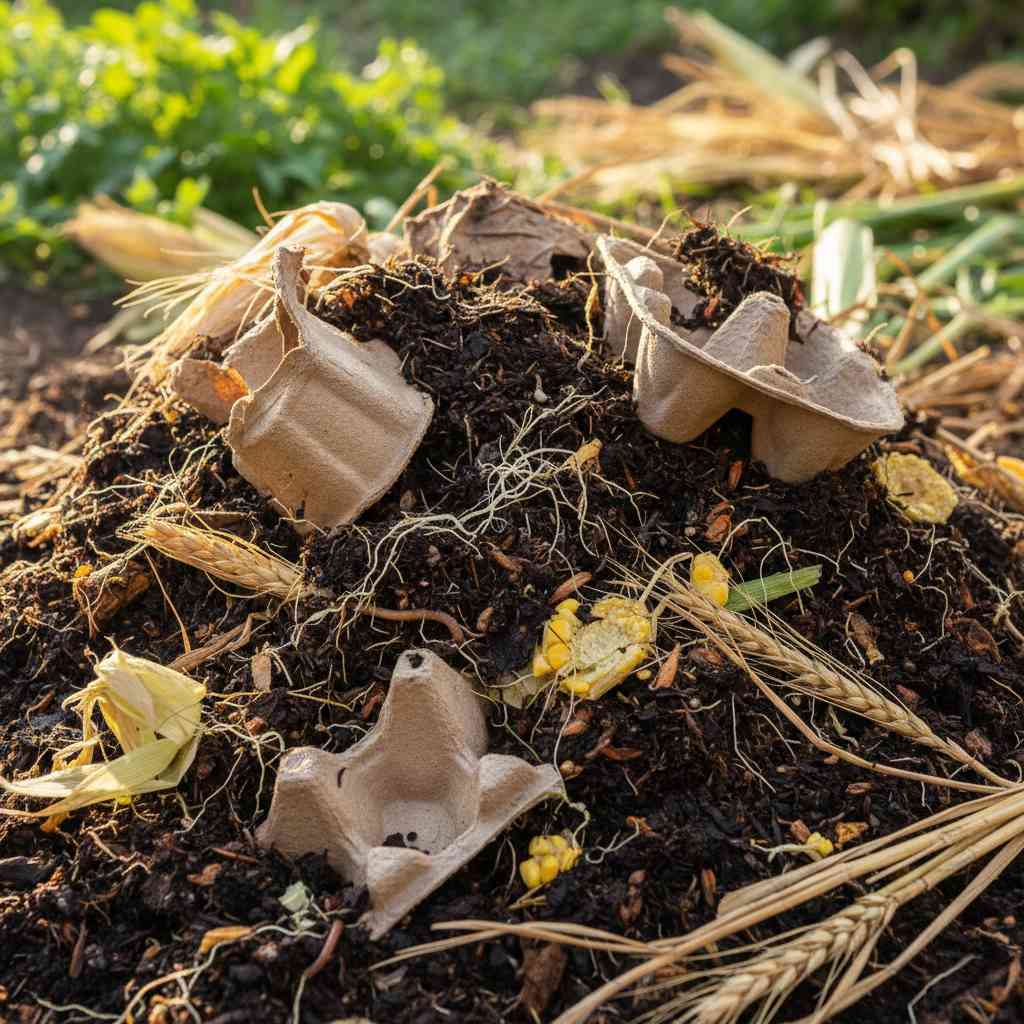
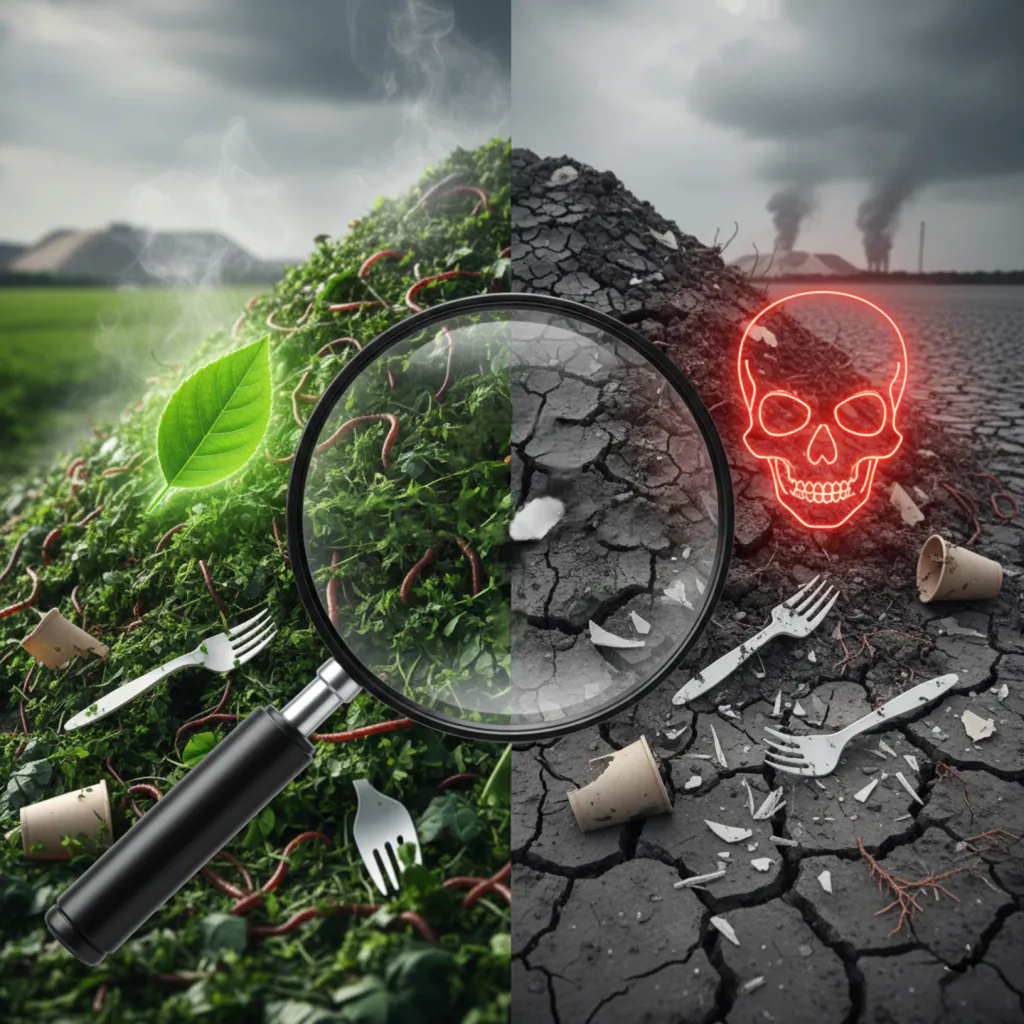
In the fight against plastic pollution in the world, the word “compostable” has almost taken on a moral tone. For many farmers, brands, and consumers in 2026, the decision to switch to compostable materials is almost a no-brainer. It’s a simple change that will enable them to feel guilt-free about their sustainability. However, science is slowly painting a different picture.
“Compostable” is not a guarantee of environmental benefit.
It is a technical term that has very specific conditions applied to it. Recent studies, including one conducted in 2025 and published in the Turkish Journal of Agriculture, emphasize that many compostable products will only decompose in a controlled industrial composting setting. When such facilities are absent or poorly managed, as is common in agricultural and rural areas, these products will remain in soil and water for a much longer period than anticipated.
When compostable materials are in the right environment, they will compost, change soil composition, and impact the number of microorganisms present (i.e. ratios of microorganisms), which could create an effect similar to what occurs with traditional plastics. Accordingly, the issue is not always how the material is constructed but rather the surrounding environment. If an inadequate collection, processing, or disposal environment exists, then an otherwise acceptable compostable material may fail in terms of its environmentally friendly intent.
The only way to achieve true sustainability, therefore, is to move beyond the material and ask more challenging questions about context and use. The system supporting an environmentally friendly material defines how environmentally friendly it is. A well-intended component of a presently flawed system can still contribute to unintended negative impacts.
The Infrastructure Gap:
A lot of people think that compostable items just return to the land when they are thrown away. The truth, however, is that most compostable products require specific environmental conditions to break down, such as those found in hygienic waste disposal compost facilities. These facilities provide conditions which are much higher than those typically encountered in the wild (e.g. temperature, moisture, and microbe activity) for these products to breakdown successfully.
Since many areas, especially agricultural, have limited infrastructure available to provide those compost facility conditions, disposal of any compostable item in any conventional landfill results in its breakdown via anaerobic digestion producing toxic methane gas which is far more damaging to the atmosphere than carbon dioxide gas. This would lead to the conclusion that compostable products are not truly compostable unless the appropriate infrastructure exists to allow for the proper management of compost.
“Biodegradable” Isn’t Necessarily Clean:
Due to the increased prevalence of products that are biodegradable, people assume that simply because something degrades it must be free of toxins. However, “to degrade” is no guarantee of “to be safe”, particularly where sustainability of our food systems and soils are concerned.
Recent research has emerged to dispute the presumption that all compostable and biodegradable materials are safe for the environment. In 2024, a study conducted by the Institute of Environmental Assessment (IDAEA-CSIC) found that some compostable bags had higher levels of toxicity than regular plastic. This is due to their composition. In order to be flexible, durable, or have a longer shelf life, some bioplastics contain additives that can remain in the environment long after the material has begun to degrade.
The problem does not end there.
If the composting environment does not meet industrial requirements, as is usually the case in agricultural settings, these materials will not decompose completely. Rather, they will break down into what are called “bio-microplastics.” A study released in Frontiers in Sustainability demonstrates that these microplastics can build up in agricultural soils, disrupting microbial activity that is vital to soil fertility. This can lead to decreased crop yields over time.
The paradox is simple.
A material can be biodegradable on paper and still enter the ecosystem with toxic residues or persistent particles. Sustainability is not just about whether a product is biodegradable, but what it breaks down into and how that material interacts with the soil, water, and food chain.
In the world of recycling, “compostable” is often a contaminant.
One of the most common issues is the problem of misplacement. When compostable materials are put into the regular recycling stream, they become a problem rather than a solution.
For example, if a compostable bottle is put into the PET recycling stream when it is meant to go into the compostable stream, the whole bin of PETs could be ruined. An article posted on ResearchGate (2025) states that even a small amount of compostable material can make recycled plastic brittle so that it cannot be reused.
This leads to a clear lose-lose situation. The compostable item does not end up in the composting facility, and simultaneously, the recyclable plastics are not successfully recycled either. Rather than helping to close the loops, issues with sorting and material incompatibility could end up hindering the circular economy that they are intended to facilitate.
The message here is simple but not very pleasant.
Unless compostable items can be easily labeled and distinguished, they could end up hindering the recycling process rather than helping to facilitate it. Sustainability is not just about the development of new materials but also about ensuring that they are compatible with the systems that are already in place.
The sustainability of a product has to be evaluated over its entire life cycle. The majority of compostable packaging is made from corn or sugarcane. As has been pointed out in PMC (2025), if we are to scale up bioplastics globally, we are presented with the challenge of a “food vs. fuel” conflict, where the land that could be used for the production of calories for human consumption is used for the production of “sustainable” packaging.
Sustainability is more than just a word in fact it is a system.
A compostable fork can be said to be sustainable only if it meets the following criteria:
- It is made from waste materials (like algae or agricultural waste).
- It is disposed of in a composting process that has been verified as industrial composting.
- It is proven to be free from toxins (such as those required by EN 13432).
If these three conditions are not met, then the word “compostable” could be nothing more than greenwashing.